
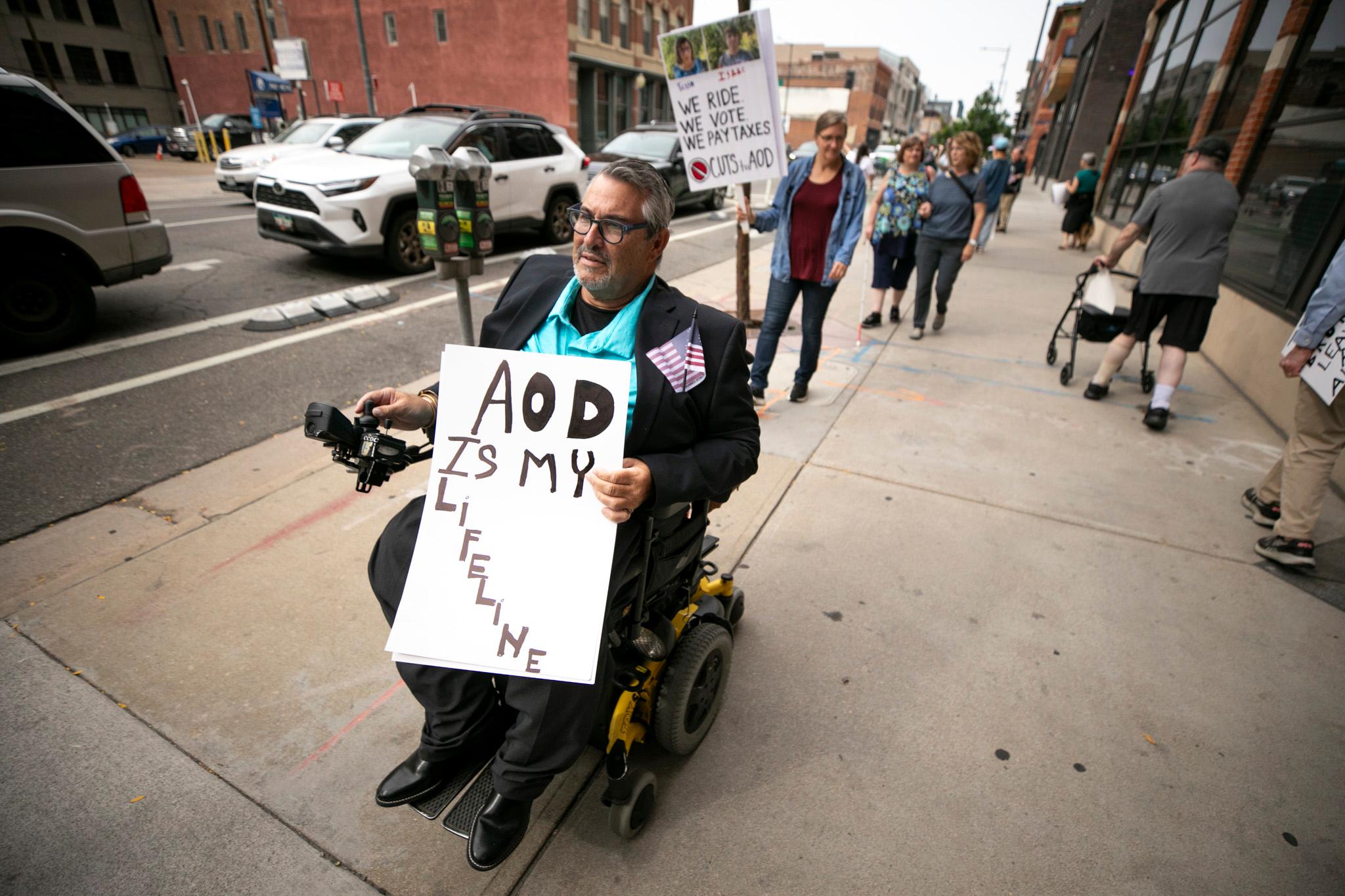
Starting on New Year’s Day, people with disabilities will pay more to use a popular on-demand paratransit program in metro Denver. The change is taking effect as planned after a federal judge declined to grant a preliminary injunction to block it.
In an order issued Monday, District Judge S. Kato Crews wrote that the plaintiffs in a lawsuit against the Regional Transportation District “have not met their burden to prove a substantial likelihood of success on the merits.” The case is ongoing.
The disability rights group Atlantis ADAPT and the activists sued RTD earlier this month over changes to the service, Access-on-Demand. The lawsuit claimed that the changes, including implementing a new base fare of $4.50, violated the Americans with Disabilities Act and the Colorado Anti-Discrimination Act, and that riders with disabilities are being singled out by RTD.
“Access-on-Demand is a lifeline for Coloradans with disabilities … It offers flexible, consistent access to workplaces, grocery stores, doctors’ offices, restaurants, and more — allowing Coloradans with disabilities to access and enjoy public space on the same terms as Coloradans without disabilities,” the complaint stated.
The plaintiffs also alleged that the changes flouted a promise made in a ballot measure passed by voters in 2024. Measure 7A allowed RTD to keep tax revenue that it otherwise would have had to refund to taxpayers under Colorado’s Taxpayer Bill of Rights. Ballot language said the excess tax revenue would go toward purposes like maintaining services for people with disabilities.
In its filed response, RTD argued the plaintiffs “have not demonstrated a likelihood of success on the merits or irreparable harm, and the balance of equities and public interest tip in RTD’s favor as a public agency with the responsibility to operate in the best interests of all customers in a fiscally responsible manner.” The agency has called its AoD program an “optional premium service” in its filing, and said it was not required under federal law to provide it.
The judge seemed to agree, determining that RTD’s changes to AoD do not violate the ADA “and Plaintiffs have failed to identify some facially neutral policy or procedure that has a disproportionate impact on disabled persons. They instead point only to Defendant’s single action of making unflattering changes to an optional program the law does not require Defendant to provide in the first instance,” wrote Judge Crews.
In a statement released Tuesday morning, RTD General Manager and CEO Debra A. Johnson said she was “pleased” with the court’s decision.
“As a steward of public funds, RTD remains committed to making fiscally responsible decisions that optimize service availability and the customer experience for all who utilize its bus, rail, and paratransit services,” Johnson said.
In its own statement, ADAPT Colorado said Johnson’s “attempt to frame this procedural ruling as validation is misleading.”
The statement read: “A denial of a preliminary injunction is not a finding that RTD is right, nor that people with disabilities are wrong … RTD’s Board of Directors’ determination to ignore the disability community, and inflict harm on us while management mysteriously lost 250 million taxpayer dollars is not good stewardship. It’s dereliction of duty and willful resistance to civil rights.”
Access-on-Demand launched as a pilot project about five years ago. It offers subsidized, on-demand rides for qualified riders via certain ride-share and taxi companies. The flexibility and affordability appealed to paratransit riders, and it became a popular program. AoD had about 3,400 users in August, according to the lawsuit.
RTD officials have said increasing ridership has made AoD unsustainable. Overall, RTD is operating a record $1.5 billion budget in 2026, but it faces a “structural” deficit and officials have said they’re worried about the long-term budget implications of the on-demand paratransit program.
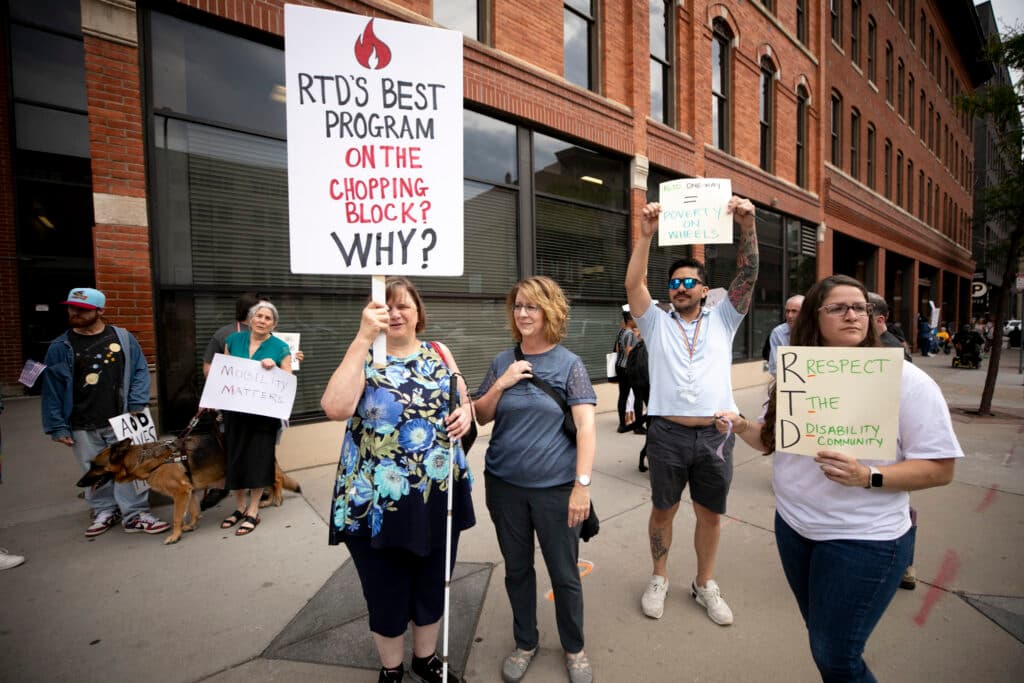
But advocates have pushed back against the agency’s claims about the program’s financial viability, and riders and RTD wrestled over the issue for well over a year.
RTD’s Board of Directors approved the changes in late September in a 10-5 vote, reducing the RTD subsidy from $25 to $20 per ride and implementing a base fare of $4.50 per ride, or $2.25 for those who qualify for RTD’s income-based discount program. Other modifications included reducing the service’s availability by a couple of hours per day. The Sept. 30 meeting included hours of public testimony on how the service has impacted people’s lives for the better, and the final vote was met with audible cries of disapproval.
As the debate around AoD changes intensified, transit and disability advocates have also called on RTD to do a more comprehensive study, including a deeper look at its older Access-A-Ride service, to understand how well the agency is meeting the needs of the region’s disability communities. Several board directors have also signaled support for a “holistic review” of the agency’s entire paratransit system, and the state legislature’s RTD Accountability Committee voted earlier this month to recommend that RTD “undertake a comprehensive analysis and planning effort” as well.
In a statement to CPR News, Director JoyAnn Ruscha, who voted against the modifications, said she hopes the next board chair “takes an all-hands-on-deck approach to paratransit.
“All of this focus on Access-on-Demand took the spotlight away from Access-a-Ride, which is facing a myriad of problems right now. For some riders, it's not even usable,” she wrote. “It is important to remember that what is legal is not always just. Meeting the bare minimums of anti-discrimination laws in public transit is like waking up and finding the floor.”
Who is ADAPT?
Over the last several decades, ADAPT has played a key role in the disability rights movement in the U.S.
It was born out of a historic protest for accessible public transit, when a group of 19 activists, known as “The Gang of 19,” brought downtown Denver traffic to a standstill by using their bodies to block two RTD buses for roughly 24 hours in July of 1978. They demanded accessible transit as they chanted: “We will ride.”
The group was a driving force in demonstrations in the U.S. Capitol in 1990, credited with getting federal lawmakers to pass the ADA. Over the summer, RTD’s Board of Directors voted to rename its downtown Civic Center Station in honor of the late Rev. Wade Blank, who co-founded Atlantis Community and was instrumental in organizing The Gang of 19 and early ADAPT activism.
“Whatever legal definitions RTD now relies on, this is not what voters thought they were approving. The RTD gravy train stops here,” ADAPT’s Tuesday statement continued.