
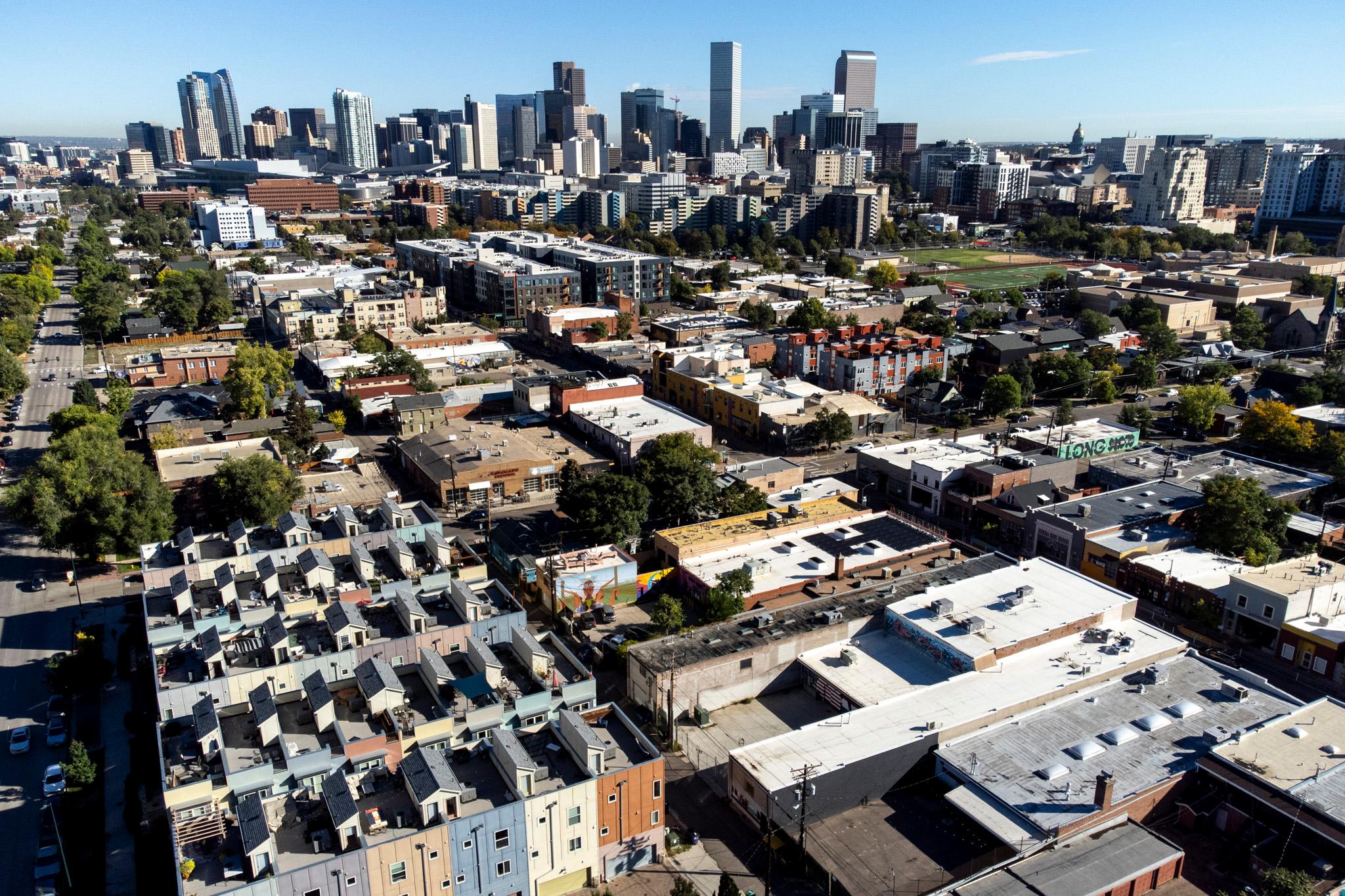
The population of Denver shrank slightly last year, with the population of the Queen City of the Plains shrinking by about 1,000 people from summer 2024 to summer 2025.
That’s according to the latest U.S. Census estimates, which have Denver shrinking by about 0.1%. Meanwhile, neighboring Jefferson County was stagnant, and Arapahoe County saw the sharpest population drop in the state.
The drop in Denver was driven by people moving to other cities and states.
The city lost about 8,000 people who moved to other places in the U.S. That was somewhat balanced out by thousands of new births and also limited new arrivals from other countries, adding up to the total population loss of about 1,000. A similar pattern played out in other slow-growth areas.
Some of the departures could be driven by factors like the cost of living or a preference for the suburbs. But the exits also include international immigrants who may have only lived in the city for a short time. Detailed data on migration isn’t yet available.
"What we see is that the areas that saw the strongest international net migration in 2024 are seeing the slowdowns, relatively speaking, in 2025," said Kate Watkins, state demographer for Colorado. "And the story there is largely that we had elevated levels of net international migration into the U.S., largely made up of humanitarian migrants. And some of those individuals came to Colorado and decided not to stick around."
Overall, she said, the drop in Denver is "really, really small potatoes in the grand scheme of things."
Meanwhile, several other suburban and exurban counties grew at moderate rates.
Weld County in northeastern Colorado saw the state’s greatest population jump as exurban development spread across former agricultural areas. It added more than 7,000 people for a growth rate of 1.9%.
Douglas County led the way in the Denver metro, with growth around cities like Parker and Highlands Ranch contributing to an increase of some 6,300 residents and 1.6%.
In southern Colorado, El Paso County — home to Colorado Springs and also the state’s most populous county — grew by about 4,700 residents, or 0.6%.
The growth in most of those areas was driven by domestic migration from other U.S. cities.
"Along many of the edges of the more metropolitan areas, that's where we've seen more growth among those counties. And so largely we're seeing many of the trends that we've been seeing for decades across many areas of the state," Watkins said.
She added: "Especially if you're looking cumulative over multiple years, say going back to 2020, it's the same counties that have seen the strongest growth, both in populations, jobs, and housing permits," she said.
Meanwhile, boomtowns in the South grew much faster than anywhere in Colorado. Harris County, home to Houston, Tex., added nearly 50,000 people. In North Carolina, the counties that host Raleigh and Charlotte both added nearly 30,000 people.
Still, there are some indications that the Denver area continues to draw new residents from other areas, even as the scales shift. A new Bank of America report found that the Denver metro was attracting transplants at the third fastest rate in the nation.
At the same time, the nation's most populous county saw a decline: Los Angeles lost more than 50,000 residents.
The new statistics provide more detail about Colorado's slowing population growth.
The state’s population grew by roughly 0.4% last year, its slowest growth rate since the late 1980s.
“We have definitely slowed in the growth categories,” Watkins told us in an earlier interview. “We have slowed relative to other states. We also have come off a period of strong growth.”
A sharp decline in international immigration also has slowed growth in Denver and across the nation. In the early 2020s, the arrival of tens of thousands of new immigrants to Denver swelled the city’s population — but with an immigration crackdown, that trend has slowed dramatically.
The last time Denver lost population was in 2021, amid the pandemic. Overall, the city has added about 20,000 people since 2020, and the Denver metropolitan area has made up most of the state's population growth.
The city has seen far more dramatic changes before. In the 1980s, Denver’s population dropped by some 30,000 people amid the oil bust — before exploding in recent decades. The early 2000s also saw a slight dip during the dot-com recession.
Meanwhile, the state's population has been buoyed by babies.
"Statewide, we did see an uptick in the number of births," Watkins said, "and that's really distributed across the state, but generally speaking, in our younger and more populated counties."
Colorado ranked 29th nationally for its growth rate in the year leading up to July 1, 2025. The states with the highest growth rates are South Carolina, Idaho, North Carolina and Texas.
Nationwide, about 75 percent of all counties saw slower or negative population growth, The New York Times reported this week.
Editor's note: This article was updated with comment from State Demographer Kate Watkins.
Madilyn Rose contributed to this article.