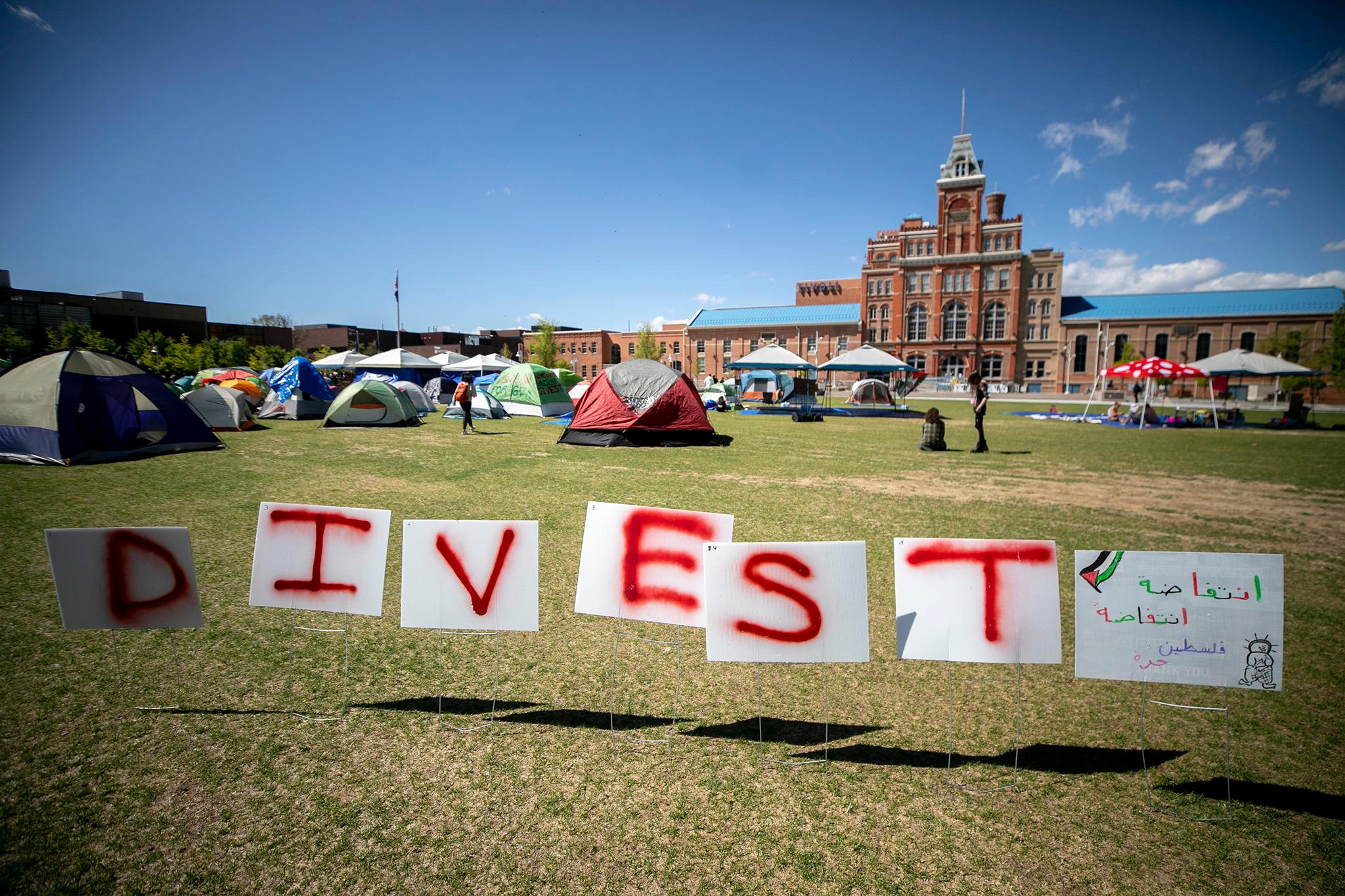
A federal committee has released its report following a year-long investigation into alleged antisemitism on the Auraria Campus.
The report was commissioned in the wake of the anti-war encampment that brought hundreds of people to the campus quad in spring 2024 to protest the war in Gaza. The U.S. Commission on Civil Rights called on the committee to “examine the nature, prevalence, and impact of antisemitism on college campuses in the current context.”
It was quietly released on May 14. The report did not find widespread instances of antisemitism, but alleged that protesters were given special exemptions from law enforcement and that Jewish students were unable to participate in campus events and activities due to the disruption caused by the protests.
It also targeted the leadership of Mayor Mike Johnston, even calling into question whether he upheld his oath of office while overseeing the city’s response to the encampment.
The mayor’s office has dismissed those charges as kowtowing to the Trump administration, which targeted pro-Gaza protesters in the first few months of the president’s second term. The process for drafting the report also drew criticism from one committee member who later resigned.
A 164-page report
The protest camp sprang up in late April 2024 in response to Israel's ongoing war in Gaza. Israel invaded Gaza in response to the Hamas attacks on Israel on Oct. 7, which killed close to 1,200 Israelis and took 200 more hostage. Israel’s subsequent military campaign would result in the deaths more than 70,000 people in Gaza, catalyzing protest camps like the one in Denver.
The committee heard testimony from officials from the three higher education institutions that call the Auraria Campus home, legal experts, protesters, and members of the local Jewish community.
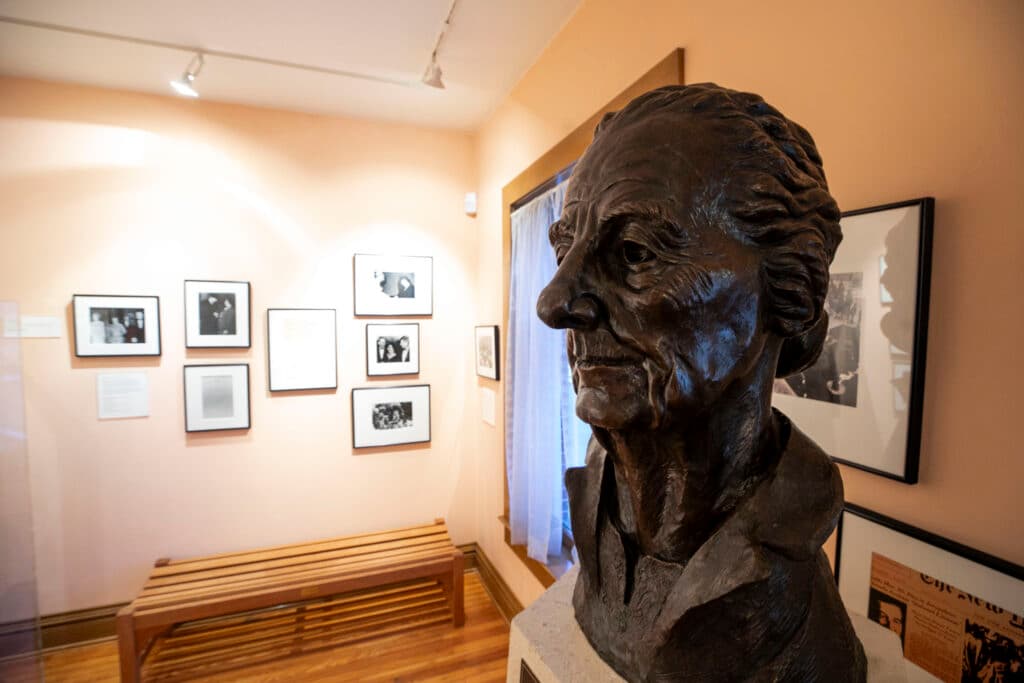
The report included detailed timelines on the encampment, such as protests at the Golda Meir House Museum, the house where former Israeli Prime Minister Golda Meir lived during her formative years in Denver. Meir’s legacy has been criticized by pro-Palestinian protesters for her rejection of Palestinian identity. (Meir was quoted as saying, “There is no such thing as Palestinians," in 1969; she later said that she meant that there had never been a Palestinian nation.)
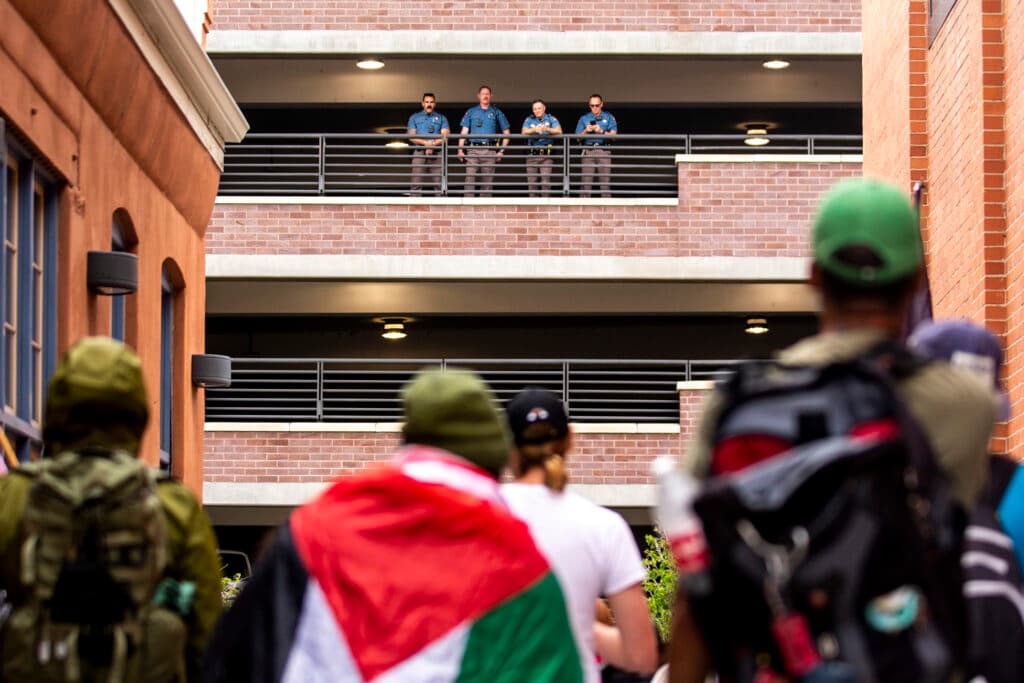
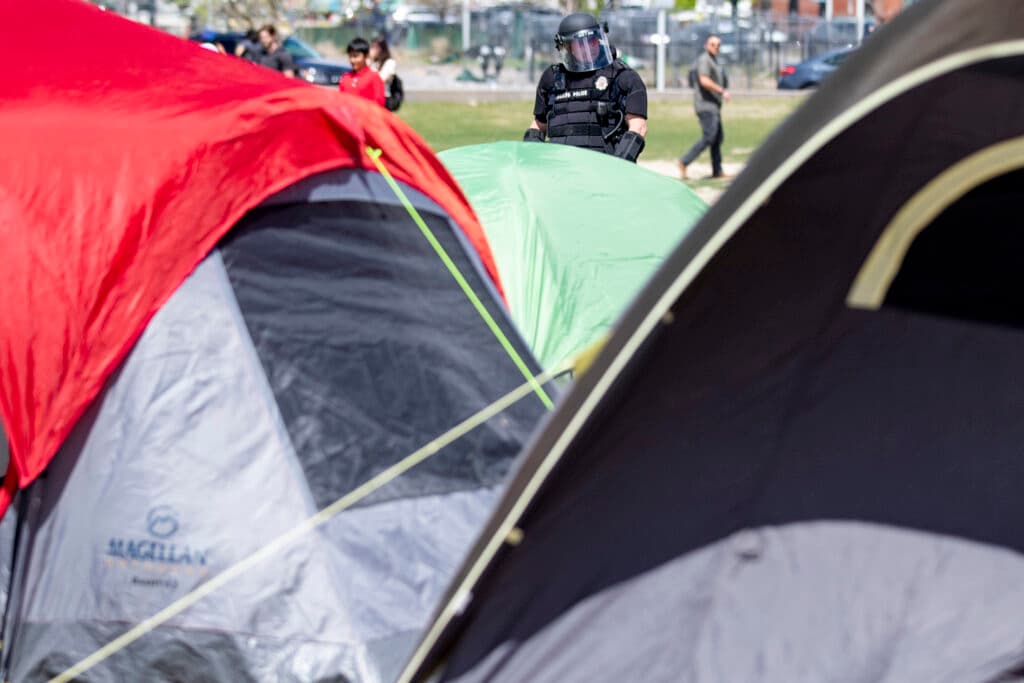
Soon after the encampment began in Denver, police arrested about 40 protesters. The camp restarted mere hours later, with no subsequent attempts to break it up by force. For the next month, protesters and campus officials faced off in minor skirmishes, with some protesters blocking roads and occupying campus offices.
City officials, including Police Chief Ron Thomas, characterized the protest as peaceful. Behind closed doors, Auraria Campus officials, who are independent of the city, pushed back on that characterization, though there weren’t any documented instances of violence.
The federal committee report did not weigh in on the peaceful nature of the protest, but it stated that “some protesters’ conduct and speech was antisemitic.”
It cited the use of certain chants, like “From the river to the sea, Palestine will be free.” While many protesters characterize the phrase as a rallying cry for the liberation of Palestine, others describe it as a call to erase Israel from existence.
“While choosing to use slogans that have been relentlessly used by persons engaged in violent crimes against Jews, the protesters themselves articulated these menacing slogans while engaging in menacing behavior, including forcible invasion of the spaces of other persons, and using sound amplification as a weapon to make common campus spaces unusable by others,” the report state.
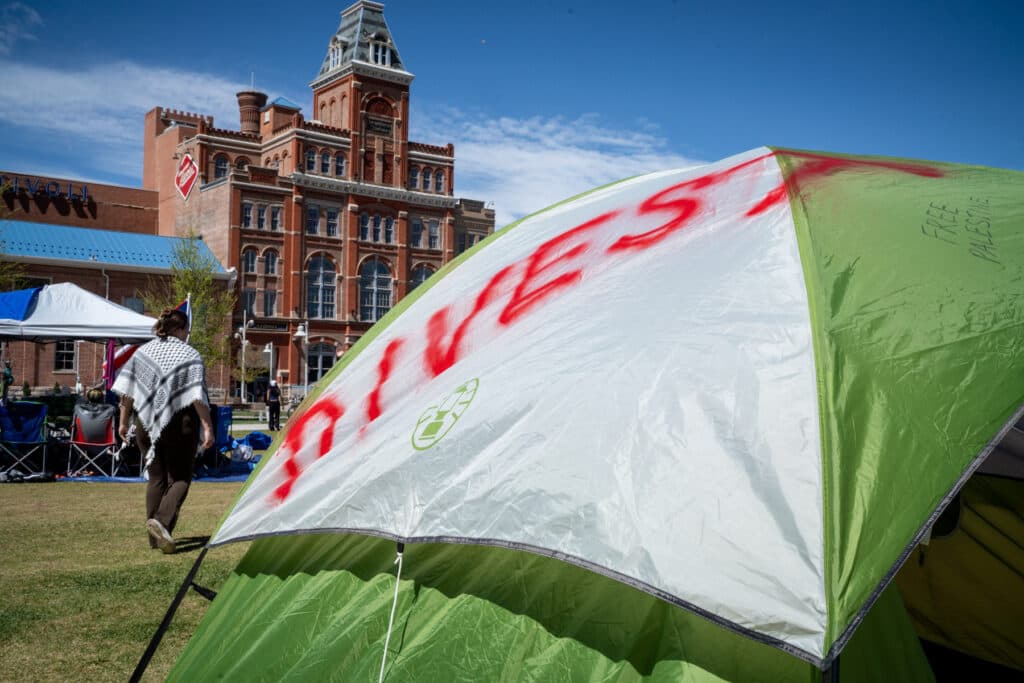
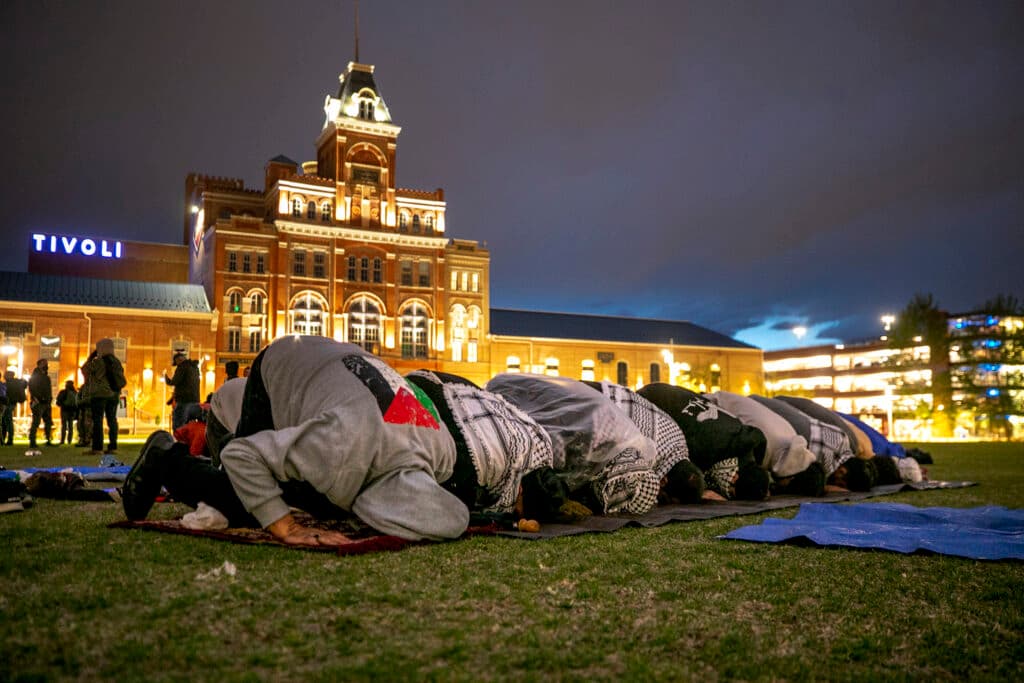
Protesters have continually denied allegations of antisemitism. In testimony given to the committee, dozens of protesters and their allies said the encampment encouraged and welcomed Jewish participants.
“Another participant recounted, ‘my Jewish perspective was celebrated, my Jewish perspective was taken into account in terms of our organizing of demonstrations in terms of our chants and in terms of our speeches,’” the report said.
Daniel Bennett, Hillel of Colorado’s executive director, told Denverite last year that some speech crossed the line into antisemitism.
“Unless you start from the premise that my people have a right to have a democratic independent state in their historic homeland, we can't really talk,” he said.
The report also found that the protests, namely the ones focused at the Golda Meir House Museum, prevented Jewish students from accessing services on campus.
The report also targeted city leadership
The authors took several shots at city leaders, including certain members of Denver City Council, Mayor Johnston, Denver police and the city attorney.
Protesters were given “special exemptions from law enforcement” due to the interference of city leaders, the report alleged. After the initial encampment arrests on the second day of the protest, city officials decided not to participate in potential future sweeps, noting that it was a peaceful gathering.
The report even alleged the city violated the Fourteenth Amendment, which guarantees all citizens equal protection of the laws. In one section, the authors wrote that Johnston failed to uphold the oath he took when he assumed his office.
The city pushed back against the critiques. Miko Brown, the Denver city attorney, even sent the committee a cease and desist letter demanding that it not publish its accusation that the city broke the Fourteenth Amendment.
“If you cause legal action to be brought against Denver and its officials related to the false allegations contained in your report, Denver will seek all legal remedies available. There is no evidence Denver officials violated the Equal Protection Clause,” Brown wrote to the committee on March 30.
In a statement sent to Denverite, the mayor’s office dismissed the report as another attack on Denver by the Trump administration.
“This report cares more about responding to pressure from the Trump Administration than it does presenting actual facts,” mayoral spokesperson Jon Ewing said in an email. “Denver Police should be commended for supporting partners, de-escalating a volatile situation, and protecting the rights of peaceful protesters. Auraria has jurisdiction over its campus, and we will always prioritize collaboration that keeps people safe and upholds constitutional rights.”
Criticism of whether the report met its goal
When the report was commissioned, it had three guiding questions:
- What are university and college campus policies around antisemitic discrimination?
- How did university and college administrators address recent incidents of antisemitism?
- How are antisemitic incidents documented and/or reported?
Alex Boodrookas, a tenure-track professor of Middle East history at MSU Denver who was present at the protests, sat in on all of the committee’s meetings. He said it quickly lost sight of those guiding questions.
“It looks like this report is being used as a political football to go after progressive elected officials in the Denver government,” Boodrookas said. “That seems to be what the report is designed to do, and in a context where antisemitism allegations are being rather cynically weaponized against protesters across the country. I see that as incredibly dangerous.”
The committee was divided at times. Darrell Jackson, a law professor at the University of Wyoming, told the group in its December 2025 meeting that he was uncomfortable with the suggestion that the protesters or the city were committing crimes.
“Once we start getting into, ‘Wow, we've decided these are potential crimes,’ we've entered into a whole ‘nother territory, and to one I am not comfortable signing [onto] at all,” he said.
The committee later cut a section from the report that outlined crimes allegedly carried out by the protesters, but Jackson resigned from the committee a month after his comments. Jackson could not be immediately reached for comment.
What's next?
The committee made several recommendations, none of which are guaranteed to happen.
Although the University of Colorado Denver requested that the committee make recommendations about “policy changes that could help colleges and universities in Colorado address antisemitism on campus and improve the climate for Jewish students and employees,” all recommendations instead focused on how to deter protesters from disrupting campuses.
That included the idea that federal and local agencies use civil lawsuits to discourage future disruptive protests from occurring.
“Instruct U.S. Attorneys to be ready to use federal criminal law powers when colleges and universities—or portions of their campuses—are taken over by mobs, and local law enforcement sits idle,” one recommendation said.
Educational institutions and faculty or student groups should “consider defending their campus against mobs by bringing civil lawsuits,” another recommendation stated.
The Auraria Campus did not respond to a question about whether it plans to take any action following the report’s publication.
“We are pleased that the report found Auraria acted appropriately, within its authority and capacity, and with due respect for civil rights. The Auraria Campus remains committed to prioritizing the health and safety of our community while ensuring continuity of our academic mission. We value our collaborative relationships with city, state, and federal partners and remain focused on strengthening communication, coordination, and cooperation among all campus stakeholders and partners,” wrote Auraria Chief of Staff Sophia Tran.