By Cassis Tingley
After more than a year of back-and-forth with the city’s oversight body, the Denver Police Department on Tuesday rolled out a new alternative to discipline for low-level misconduct by officers.
The department first proposed the new policy last winter. Now, after at least three rounds of edits, questions from the Denver City Council and a dispute over DPD transparency requirements, the policy will offer educational training as a substitute for formal penalties in many cases. The new policy will cover roughly 60% to 65% of the department’s misconduct cases.
The new method is called “Education-Based Development” because, in the words of safety department official Wendy Shea, “It’s really not discipline.”
Officers who choose to participate in EBD will receive offense-specific training instead of the penalties required under the current disciplinary matrix.
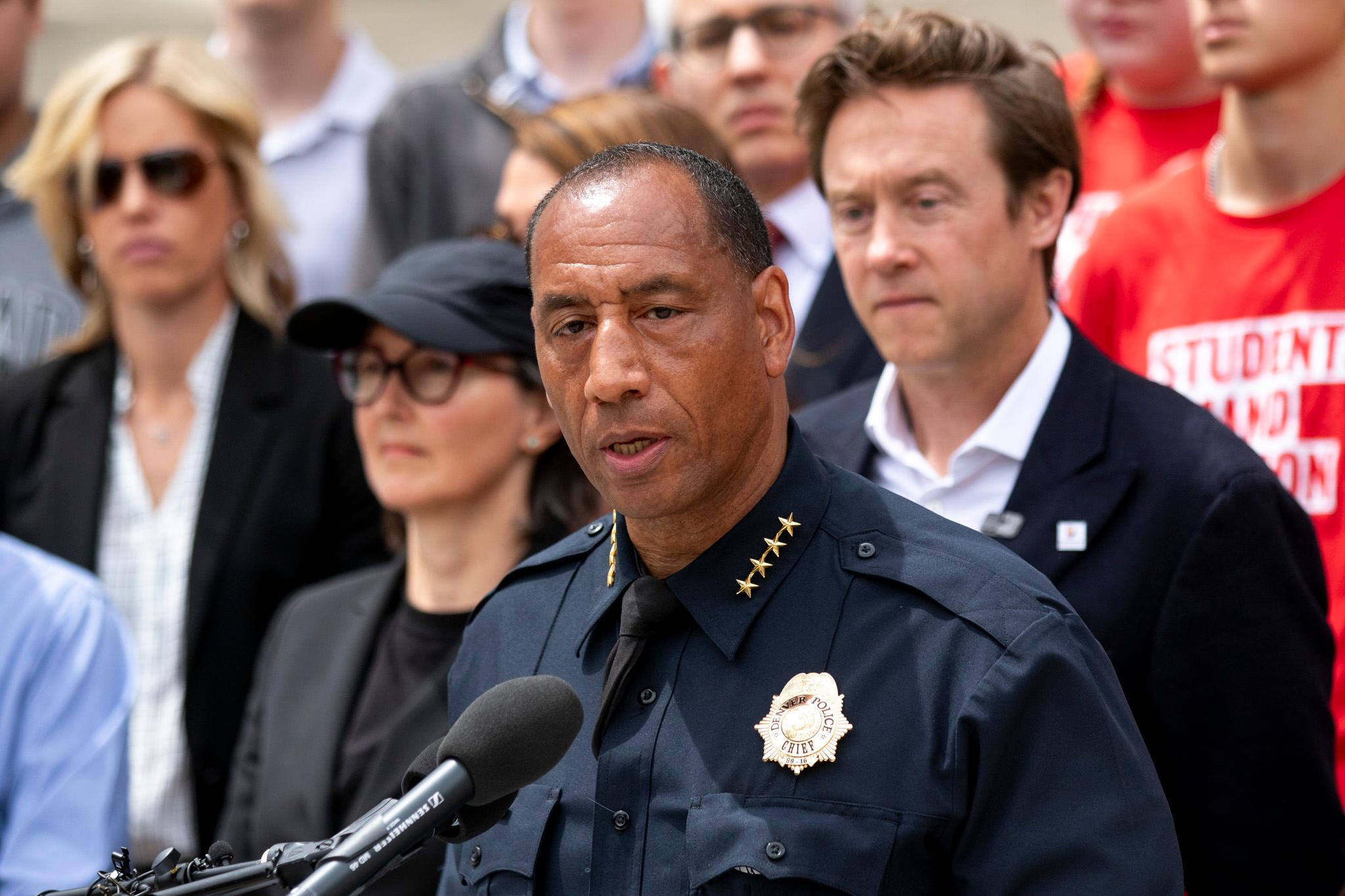
Police Chief Ron Thomas argues the changes are necessary to secure “faster and more meaningful accountability” for misconduct.
“I don’t think this is an opportunity to limit consequences; I think this is an opportunity to better train our staff when they make those very low-level mistakes,” he said in an interview.
But Independent Monitor Liz Pérez Castle sees things differently. She says while the current disciplinary system can take time, rolling back accountability measures goes against city law and community expectations.
“They're just thumbing their nose at the ordinance, which, there's been a pattern of that with the rollout of EBD,” Pérez Castle said in an interview, referencing the city’s OIM policy. “This is a step back for the community because it is taking away the accountability that community fought so hard for.”
Who can choose “development,” and how often?
Officers are only eligible for the “development” path for incidents of A- or B-level misconduct, the department's lowest-level infractions.
Penalties for A- and B-level offenses under the current disciplinary matrix range from an oral reprimand to a week's suspension depending on prior violations and the impact of the offense.
Officers who want to use EBD will have to get several levels of approval, including an initial decision by internal affairs, a recommendation by the independent monitor's office, and approval from the department's accountability bureau.
Chief Thomas defended the program’s merits in an interview.
“There is still a consequence of you having an infraction on your record, even though rather than receiving a written or an oral reprimand, you did receive training for it,” he said. “If there is another similar infraction then you move directly into a situation where you can be held accountable with a fine or a reprimand.”
Thomas denied that officers could use EBD for repeat offenses, saying at a city council committee meeting that he trusted Internal Affairs to recognize repeated misconduct.
However, Shea confirmed that officers can choose EBD instead of discipline once every 12 months for A-level offenses and once every 18 months for B-level offenses, as long as they aren’t under an ongoing investigation.
“What I’m hearing the Chief and Wendy say is, EBD is not a one-time thing,” Pérez Castle said during the safety meeting. “That is concerning to me because that opens the door to having EBD (be) discretionary.”
A-level misconduct, which includes infractions like off-duty uniform violations and failure to respond to department communications, will require four hours of training. B-level misconduct covers more serious issues like discourtesy and soliciting business from the public, and it will require a 10-hour course in decision-making and four hours of training.
If an officer fails to complete the training, their case will be reverted to the existing disciplinary process.
Police departments in Los Angeles and Austin have also adopted education-based discipline policies similar to Denver’s.
What’s up with the surveys?
DPD used a community survey to support the new development policy — another hot topic at the June 10 safety meeting.
The survey in question was shared with participants of DPD outreach meetings last summer via QR code and was later posted on the department’s website for several months. The 1,000-odd responses are the backbone of DPD’s claims that EBD has widespread community support—but so far, DPD hasn’t shared those responses in full with anyone, including the independent monitor.
Pérez Castle says this is a major violation of the independent monitor’s mandate, which states that the police must give the monitor’s office “complete access” to its records. Despite multiple requests, Pérez Castle has only received what she called “anonymized summaries” of the responses, making it impossible for her to independently verify the survey results.
Chief Thomas, on the other hand, insists that he gave the OIM the “raw data” from the surveys, though he acknowledges that he withheld respondents’ names and contact information on the advice of the city attorney. He also said DPD wanted to protect respondents’ privacy, though the independent monitor regularly handles confidential information as a part of its day-to-day operations.
The City Attorney’s Office declined to comment.
This caught the attention of several council members — Councilmember Shontel Lewis agreed that the independent monitor needed the full results to have an informed opinion about EBD, while Councilmember Amanda Sawyer noted that this was part of a “really concerning trend” of inconsistent communication with the city attorney’s office.
The survey also drew criticism for failing to collect demographic data or addresses, meaning the department has no data on which communities were represented in the survey responses.
DPD said its staff didn’t work with anyone with a background in surveying and analytics to put the surveys together, and Councilmember Gonzales-Gutierrez also noted that the survey didn’t include any open-ended questions and that most questions were framed in the affirmative.
A turbulent time for community trust
The rollback of formal discipline comes as the public is dealing with other revelations in law enforcement and security technology. To local advocates, these things go hand in hand.
“We are seeing obviously on the federal level, a whole expansion of a federal police force, right?” said Casey Childers, director of operations at the Denver Justice Project. “That ties directly to the expansion of mass surveillance.”
Nationwide trust in police also took a hit last year. Gallup polling found that 45% of Americans had a “great deal” or “quite a lot” of confidence in the police last year, down from a peak at 64% in 2004.
Chief Thomas shrugged off those concerns: “I think we've done a great job in Denver differentiating ourselves from what is happening at the national level,” he said.
To the independent monitor, the switch to EBD is a way to shirk accountability.
“Once again, we’re back to police policing themselves, when they don’t engage with community and when they refuse to hold officers accountable,” Pérez Castle said. “They’re systematically trying to dismantle oversight.”
Questions and comments? Drop a line.