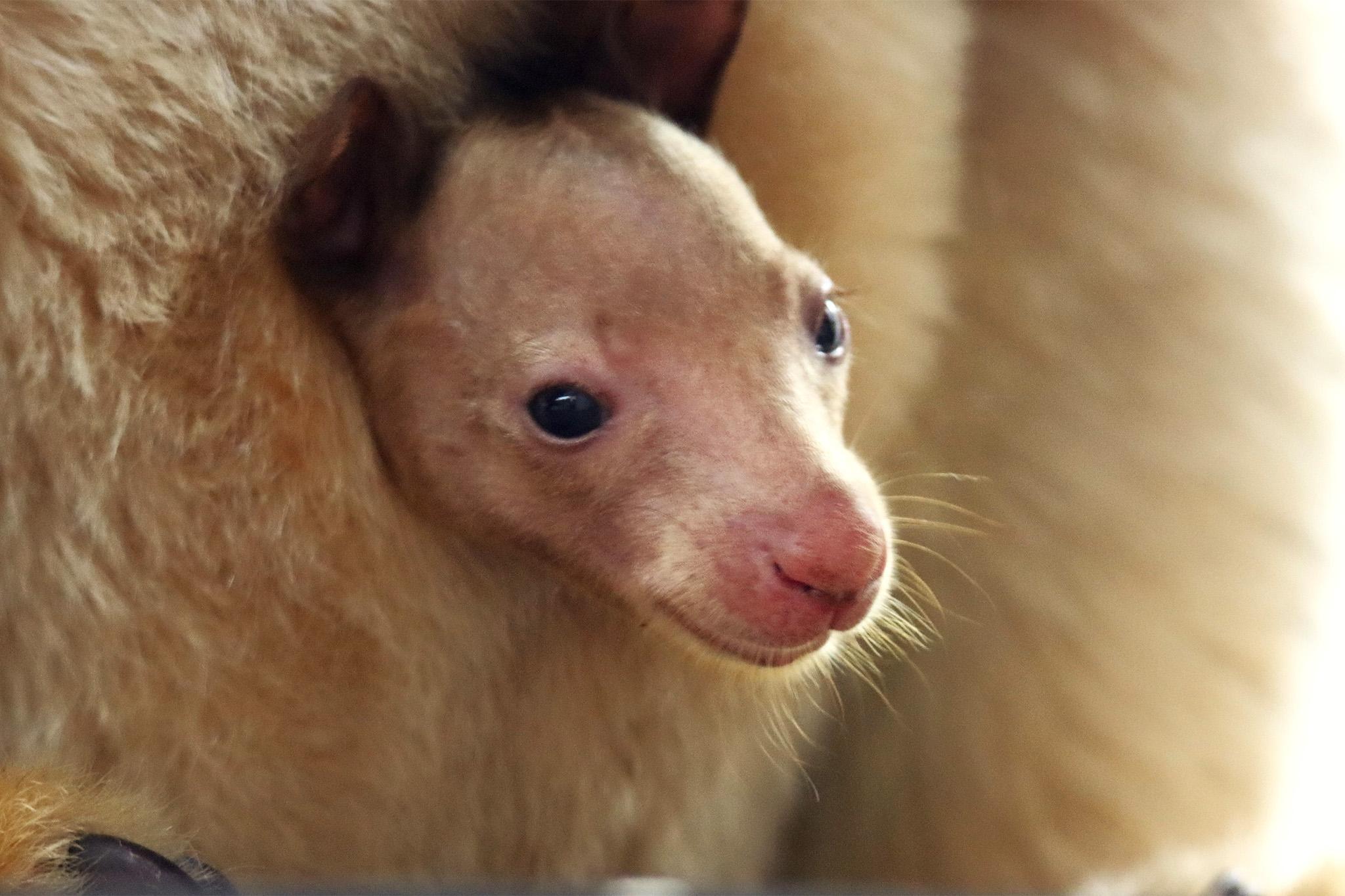
The Denver Zoo is welcoming a baby tree kangaroo to the world, born to parents Pearl and Tristan.
The currently unnamed Huon tree kangaroo was technically born in July 2025. But thanks to the unique birthing habits of marsupials (more on that below), the baby has been developing in his mother’s pouch until he was ready to emerge again.
He’s still not fully cooked, however — the zoo said he will hang out in his mother’s pouch for the next few months, before he leaves it behind for good. In the meantime, visitors to the zoo’s Down Under habitat may see the baby poke his head out of the pouch.
Marsupial mating habits are pretty weird.
Tree kangaroos are marsupials in the macropod family, closely related to animals like kangaroos, koalas and wombats.
During her estrous cycle, the female releases a single egg in one or her uteruses. Then, in a mating session that can last up to an hour, the male uses his slender, tapered penis, which has a head covered with small, sharp spines, to deposit semen in both vaginal canals. (Other marsupial males have bifurcated penises to correspond with two canals, but not macropods.)
The marsupial mother gives birth not too many weeks later, but the baby is extremely undeveloped. For Huon tree kangaroos, they are "about the size of a jellybean", according to the Denver Zoo Conservation Alliance. The tiny baby — also known as a joey — crawls into the mother's pouch, where it continues to grow, staying warm and feeding on milk.
The joey will initially venture out of the pouch after seven or eight months, but it won’t permanently leave for another couple months after that. Meanwhile, the mother is ready to mate again within 13 to 15 months after the birth.
Another bit of marsupial gestational trivia:
Many marsupials have the ability to pause their pregnancies. There’s no indication that tree kangaroos can do it, but many other kangaroos can.
This ability, known as embryonic diapause or delayed implantation, allows some marsupials to hold an embryo in something like suspended animation — delaying its development, in some cases, until an older sibling is done suckling in the pouch.
The reproductive condition described above is referred to as delayed implantation, also referred to as embryonic diapause, and it has not been observed in tree kangaroos.