This story was originally published by Chalkbeat. Sign up for their newsletters at ckbe.at/newsletters.
By Melanie Asmar/Chalkbeat
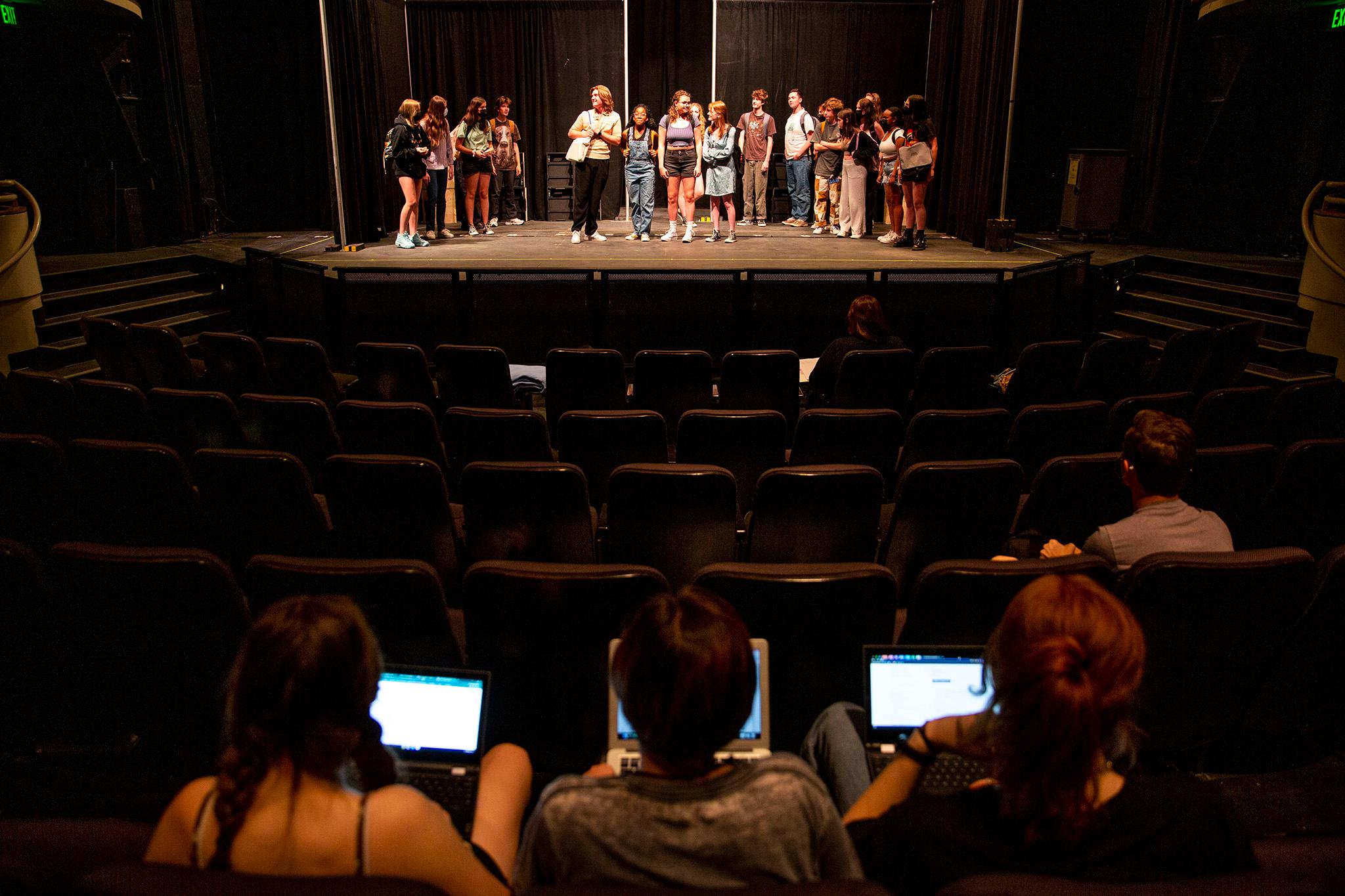
Tenth graders in tights, cravats, and lacy breeches performed Moliére on a recent weeknight, reciting long soliloquies full of words like “repast,” “jest,” and “impertinent wretch.” An audience of their parents and peers roared with laughter at the play from 1668. If any of the teenage actors forgot a line or missed a mark, it was impossible to tell.
The actors were students at Denver School of the Arts, one of the most prestigious public conservatory arts schools in the country. The school, which serves grades 6 through 12, has a stellar reputation, sky-high test scores, and hundreds of applicants each year. It also has a problem that it’s been trying to solve since its founding 35 years ago: DSA is not very diverse.
A bold move in 2021 was supposed to change that storyline: The $30 million purchase of neighboring property that would allow DSA to grow from 1,100 students to 1,700.
Expanding access for low-income students and students of color was core to the vision. That meant deemphasizing auditions that favor students who can afford costly private lessons and creating a separate admissions track for talented students without formal training. A skeptical school board insisted on detailed plans and annual progress reports.
Almost five years later, the expansion has been scaled back and key initiatives to diversify the classrooms and stages of DSA haven’t come to fruition. All of the sophomores starring in the centuries-old French comedy had to audition for their spots at the school. So did students in DSA’s 10 other majors, including dance, orchestra, and visual arts.
The school has grown a bit more diverse in recent years: 38% of DSA students are students of color this year, up from 31% in 2020, and the share of students who qualify for subsidized school meals, a poverty indicator, increased from 11% to 14% in that period, state data shows.
But DSA’s enrollment has been shrinking, not growing. And in a school district that prizes equity, its demographics are still wildly out of proportion to Denver Public Schools as a whole, where most students are students of color and the majority come from low-income families.
District leaders say they’re still committed to the original vision of a bigger, more diverse DSA and are partnering with a rapper and record producer on a new program that would be housed on the newer property. But a lack of funding for renovations that ballooned in cost paired with turnover on the school board, in the superintendent’s office, and at DSA itself have contributed to a retreat from a grander plan that some thought was too ambitious from the start.
“I wish we had paused on such a large purchase,” former board member Scott Baldermann said in a recent interview. “We put the cart before the horse at the time.”
Denver’s version of New York City’s ‘Fame’ school
Students and parents have described DSA as the best school in the city, a private-school-caliber education in a public setting, a welcoming safe haven, and “like a family.”
“This place has altered the course of my life in ways I could have never predicted,” student Camilo Ayadi told the Denver school board in 2024. “A place that accepted a little Arab Latino fifth grader from the southwest part of Denver who just liked to sing and turned him into a national singing champion.”
DSA opened in 1991 as a 200-student magnet program inside Cole Middle School. It was modeled after the New York City performing arts school popularized by the 1980 movie “Fame.”
Concerns about demographics were always part of DSA. That very first year, so few Hispanic students auditioned that DSA held two extra tryouts just for them, news stories said.
“Part of the problem may have been that the initial application process was a little scary to some young Hispanics,” painter and sculptor Emanuel Martinez told The Denver Post at the time. “They may not have had the track record that some of the other kids had.”
In 1998, the district bought a former fine arts center in South Park Hill to be DSA’s new home. But questions remained about the school’s diversity. School board member James Mejía called for a task force in 2002 to examine why DSA’s student body was nearly three-quarters white when three-quarters of DPS students were students of color, according to news reports.
“It’s not that they don’t get in,” the principal at the time said. “It’s that they don’t apply.”
DSA’s new, bigger campus — with the black-box theater where the students performed Moliére — opened in 2003 after a $30 million investment by DPS. To satisfy the school board’s diversity concerns, DSA had its students perform at elementary schools to drum up interest, offered school tours, and spent $12,000 to bus students from poorer neighborhoods to auditions. It worked: More than half of the incoming sixth graders that year were students of color.
The diversity gains didn’t last. And for that reason, the school board said no to repeated proposals to expand DSA over the years. But a new opportunity arose in 2021.
A big property for Denver School of the Arts, and grand promises
That year, DSA Executive Principal Anthony McWright noticed the property across the street was for sale. The district set its sights on four buildings on the former Johnson & Wales University campus: three academic spaces and a 1960s-era chapel with stained glass windows.
McWright’s ideas included remodeling the chapel as a performance space, transforming offices into science labs, and turning lecture halls into band and orchestra rooms. An outdoor amphitheater would be perfect for performing Shakespeare in the park, McWright said.
At $30 million, the deal was a steal, district officials said. Denver voters had recently passed a $795 million bond — and while it didn’t include $30 million for DSA, the district proposed paying for the property with bond premium dollars, or extra cash generated from the bond sales.
Students were excited.
“It was a big thing for us to go to a whole new campus,” said Ashley Olson, now a junior at DSA.
Tamara Acevedo, then the deputy superintendent of academics, told the school board in 2021 that the project had two goals: to increase access to DSA for all students “with a particular focus on our low-income students and our students of color,” and to build a year-round community arts hub that could host city-wide band concerts and summer art camps.
To increase access, DSA would adopt an audition-free acceptance model for talented middle school students who hadn’t had specialized training. The plan called for expanding enrollment by 600 students: 175 at the middle school and 425 at the high school.
The board was both excited and skeptical. Some members asked for “more teeth” to the district’s promises and tangible diversity targets. A resolution the board passed in May cited the audition-free pathway, directed the superintendent to create “a detailed implementation plan,” and required the district to produce an annual report on its progress for the board.
District officials seemed eager to comply.
“You’re absolutely, 100% right,” Acevedo said at the time. “This will afford a great opportunity. That opportunity will only be great if it actually realizes those goals.”
Nearly five years later, the promises made in the resolution haven’t been kept.
Acevedo no longer works for DPS and declined to comment because she left shortly after the purchase. Other former top officials who were involved in the plan also declined to comment.
McWright left DSA at the end of last school year after students and parents publicly complained that his administration was absent and unresponsive. He did not respond to requests for comment. McWright is now principal at Responsive Arts and STEAM Academy, a DPS elementary school. District officials said they asked McWright to take the new position.
Three other administrators left DSA, too. None of them agreed to be interviewed.
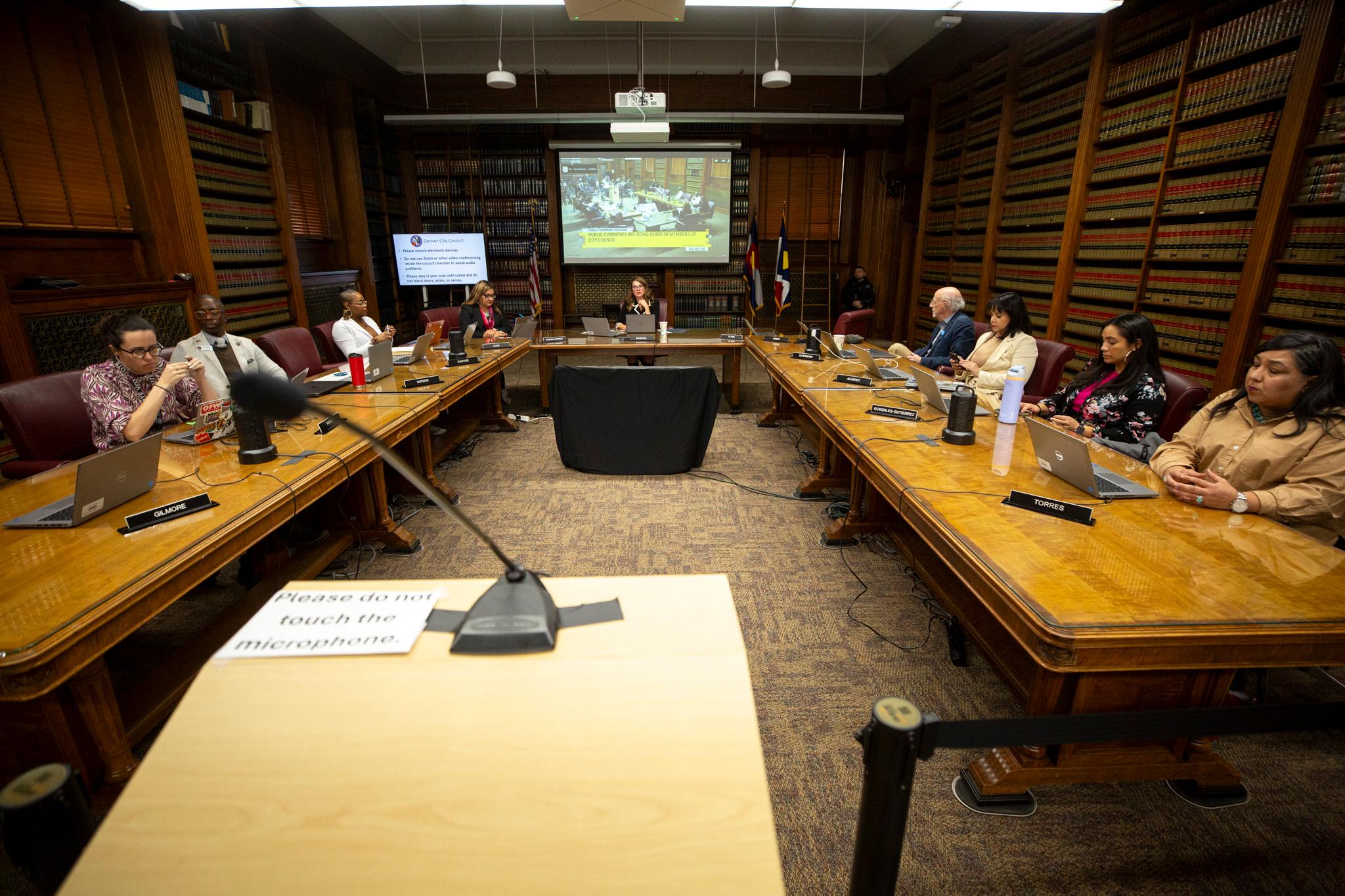
The superintendent in 2021 was an interim leader who left when current Superintendent Alex Marrero started two months later. The entire school board has turned over, too. And a change in the board’s governance structure means that old resolutions are essentially null and void.
In 2022, when the district asked for more money for the renovations, some board members said they felt like they had to say yes. Scott Esserman, who was elected after DPS bought the property, called the purchase a short-sighted investment that would “feel like an albatross around our neck” if the district didn’t move forward.
Baldermann said he was disappointed that DPS wasn’t making the arts more of a priority districtwide. Auon’tai Anderson said he worried that the vision for diversifying DSA depended too heavily on McWright — and that if he were to leave DSA, the vision would be gone too.
Help Denver School of the Arts or the rest of the district?
DPS broke ground on the renovations in March 2023. Although officials once described the four buildings as “turnkey,” unforeseen problems and pandemic-era price increases meant it cost $22.5 million to bring just one of them up to the stricter safety code for K-12 schools, according to a district spokesperson. That’s as much as quadruple the $5 million to $10 million that district officials initially estimated it could cost to fund the entire project.
In 2024, the district proposed asking Denver voters for $18.2 million more for “phase 2.” But a community advisory board that makes recommendations on spending bond dollars said no.
Alejandra “Ale” Spray, the CEO and president of the Hispanic Contractors of Colorado, was among those who considered DSA’s request. She said by email that the rejection was partly due to DSA’s low “equity index” score, which is based on demographics and need. She also noted that while the bond is funded by Denver taxpayers, many DSA students are from outside Denver.
“The choice we had was to give them that money to add seats … or to spread that money across” other schools, Spray wrote. “I guess long and short, there was only so much money so we wanted to make sure the money got spent to benefit more kids.”
In early 2025, the district sent a letter to DSA families declaring that the construction on the expansion, dubbed DSA South, was complete. The letter listed improvements to just one of the four buildings, including a new art gallery, the creation or modernization of 23 classrooms, and updates to electrical and safety systems.
DSA parents had questions.
“Without additional budget and a clear commitment, the goals of the original expansion plan remain unmet, leaving the DSA community with buildings that are not fully usable and enrollment that has not yet expanded to increase access for low-income students and improve diversity,” Kara Penn and Lisa Davis, co-chairs of a parent-teacher committee at DSA, wrote to district officials.
Penn and Davis told Chalkbeat that they wrote that email because they were at a loss. DSA had laid off staff because enrollment was declining. When parents asked why, DSA administrators didn’t have answers, Penn and Davis said.
“They’d say, ‘We don’t know why. Go ask the district,’” said Davis, whose child is now in eighth grade at DSA. The answer from the district? A lack of money for the physical expansion.
Deronn Turner, who had three children graduate from DSA and is still involved in the school, said DSA’s elite reputation likely played a role in the decision not to fund it.
“The district, they want to help,” Turner said, “but at the same time … they get caught up in thinking that the only kids that go there are rich, white, elite kids.
“Granted, there is some of that,” she said. “But I also know that there are some incredibly talented kids that do incredibly well — and they don’t have the means to have a house here in Denver and a house up in the mountains somewhere.”
A new path for diversifying Denver School of the Arts
Without more voter-approved bond money to finish the renovations, DSA had to pivot.
The hopes to expand and diversify the school now rest largely on a new program called the Iovine and Young Center for Innovation that was co-founded by Andre “Dr. Dre” Young and record executive Jimmy Iovine. Starting next fall, students at DSA and Manual High School will be able to take classes that blend design, technology, business, and the arts.
But the district doesn’t yet have all the money to pay for that program, either. The Denver Public Schools Foundation, which raises money for the entire district, is helping fundraise for it. Spokesperson Ashley Muramoto said the foundation is “in the early stages of this initiative, working closely with the district to assess specific needs” and doesn’t have an estimated cost.
Andy Mountain, a DSA parent leader, said the idea to bring the Iovine and Young programming to DSA came from the school community itself. The district’s response was “tremendous and refreshing,” he said, and reinvigorated DSA’s stalled progress.
“The opportunity presented by Iovine and Young as a springboard for additional fundraising and funding for DSA South really is a jolt of energy for the school,” said Mountain, who chairs the DSA Friends Foundation, which raises as much as $500,000 each year to pay for visiting artists and private lessons but won’t be helping with the Iovine and Young program
The district hopes to house the new programming in one of the three empty buildings, officials said. The other two buildings won’t primarily be used by DSA. One will be a satellite location for a district-run technical college and the other will once again become a church.
The district has lowered its expansion ambitions, too. The new plan calls for DSA to grow to 1,400 students by 2030 instead of 1,700, said Melissa Boyd, DPS’ executive director of secondary schools. And auditions are staying for now.
“Auditions in itself aren’t necessarily a bad thing,” Deputy Superintendent Tony Smith said.
Smith said eliminating or reducing the emphasis on auditions wouldn’t necessarily improve diversity, noting that practice requirements and additional costs to families also are barriers.
“There’s a milieu of things that you could go through that really open the door,” Smith said, “and what we’re really challenging [the new principal] to explore is, ‘What does equity look like?’ Because the outcome is going to be a more diverse DSA. The inputs could be varied.”
The new principal, Brian Cochran, was hired permanently in December. He said he believes in the vision. But his ideas are more modest. In addition to the Iovine and Young program, he’s looking at reworking the school’s schedule to allow for more classes, better advertising, and advocating for additional bus transportation for students. Some DSA buses were cut in 2023, in part because the school had few low-income students.
Parents have been receptive — and relieved at what feels like momentum.
“All those puzzle pieces … have started to really fall into place to say, ‘Yes, we are moving forward with this goal of expansion,’” Davis said. “It may not look the same that it did when the board adopted it in ‘21. The vision is still there, but the details of it do look a little different.”
Davis and Penn, whose daughter is in 10th grade, are helping organize a meeting Thursday to offer tours of DSA South and update families on the expansion plan, which some said is overdue.
“To us, this is a culmination of effort and a show of faith,” Penn said. “It’s not perfect right now, but it is definitely in the right direction.”
Melanie Asmar is the bureau chief for Chalkbeat Colorado. Contact Melanie at [email protected].
Chalkbeat is a nonprofit news site covering educational change in public schools.