By Cassis Tingley for Denverite
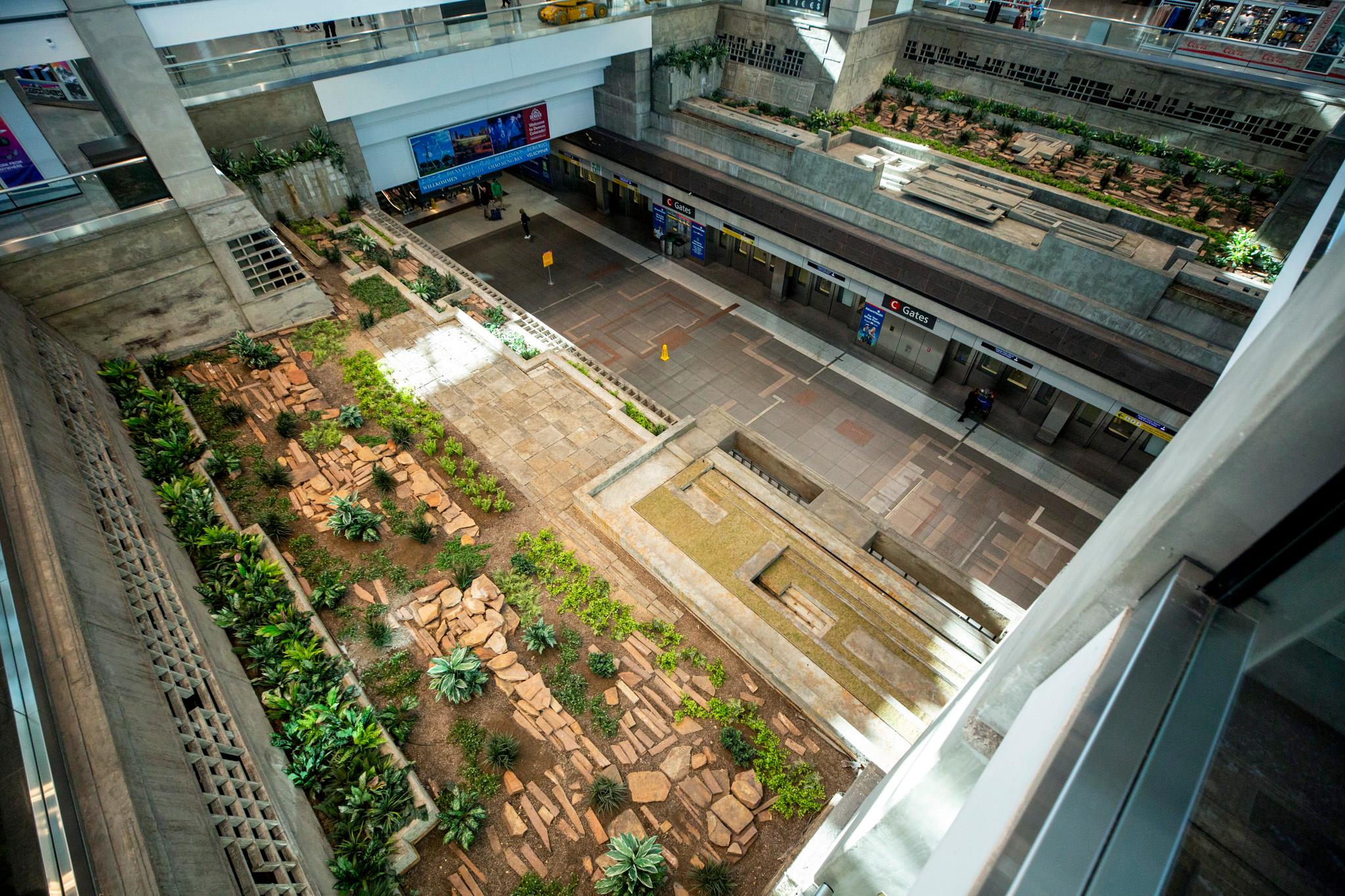
The garden in Concourse C has been drawing the eyes of travelers — and the ire of maintenance workers — at Denver International Airport for decades.
“It always makes me feel like I’m in a ‘Jurassic Park’ movie,” said Kara Funk, who travels to Denver several times a year from Tucson to see family and regularly flies into Concourse C. “It’s kinda weird. Looks like it’s space age.”
Originally installed when the airport was first built in the 1990s, “Interior Garden” was designed by the late environmental artist Michael Singer to bring green reprieve to a space dominated by hustle and sterility.
But it won’t be there forever. Due to practical issues with leaky irrigation and maintenance costs, the airport swapped the real plants out for plastic in 2022 and has been planning to remove the garden since 2017. Now, those plans are one step closer to reality.
“It probably wasn't the best decision to put a live irrigation garden above a high voltage train system,” said Marco Toscano, the airport’s customer experience director. “We don't want to see anything go. But this is one, unfortunately, because of the maintenance aspects, we just weren't able to keep it in its intended form.”
Thirty years after it was installed, airport officials plan to remove the garden to make way for more passenger circulation; a new piece of art designed by Singer; and, of course, more retail and concessions.
Last month, airport officials approved the preliminary design for “Suspended Summits,” Singer’s replacement exhibit which will feature dozens of hexagonal panels that will hang in the air above the garden’s current location in the center core of Concourse C.
The hope is to preserve at least some parts of the old garden’s legacy while creating a new piece that’s still special to Coloradans. “Summits” will be installed by Singer’s studio — this time without the irrigation drama.
The garden, meanwhile, is set to become one of just a few permanent works to ever be deaccessioned from the airport’s famous (and infamous) $14 million collection. It’s unclear when all this will happen, but it’s likely to take a few more years.
How the airport got a garden
Singer was one of the original artists invited to install work at the airport, which opened in 1995. Conveniently for Denver’s traveling art enthusiasts, the city had recently established a public art fund dedicating 1 percent of major capital improvement projects’ budgets towards public artwork — the drive to decorate Denver meant the airport had millions to spend on artwork of its own.
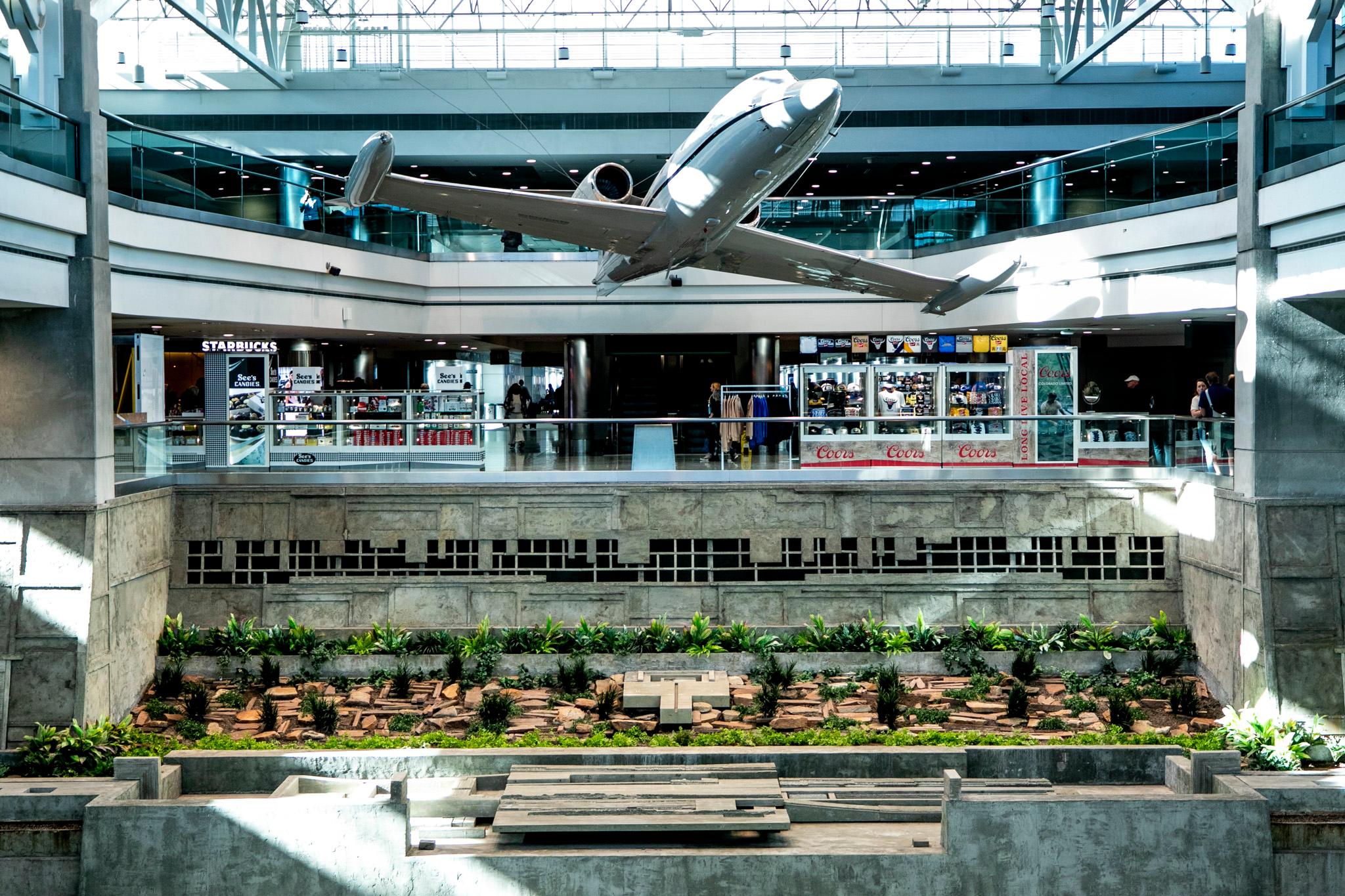
The result? Works including a fiery-eyed cerulean mustang, sprawling murals that have fueled conspiracies, a host of sculptural work, and, of course, the living rendition of an ancient temple in the middle of DIA’s finest dining establishments and knick-knack kiosks.
The garden, which Singer designed as an “oasis” for weary travelers, spans at least 5,000 square feet and was initially built for $912,000. Though luxurious airport gardens like the $1.3 billion indoor rainforest at Singapore’s Jewel Changi Airport have since become a chic essential for destination airports, Interior Garden, much more modest, was among the first.
“This was one that really forced that encounter (with the natural world). If you're walking through this concourse, you're not going to miss it. It's in your fate, and Michael loved that,” reflected Jason Bregman, a partner at Michael Singer Studio. “In terms of the (environmental art) movement, it’s a pretty foundational piece. Nobody else was doing work like that, in airports especially.”
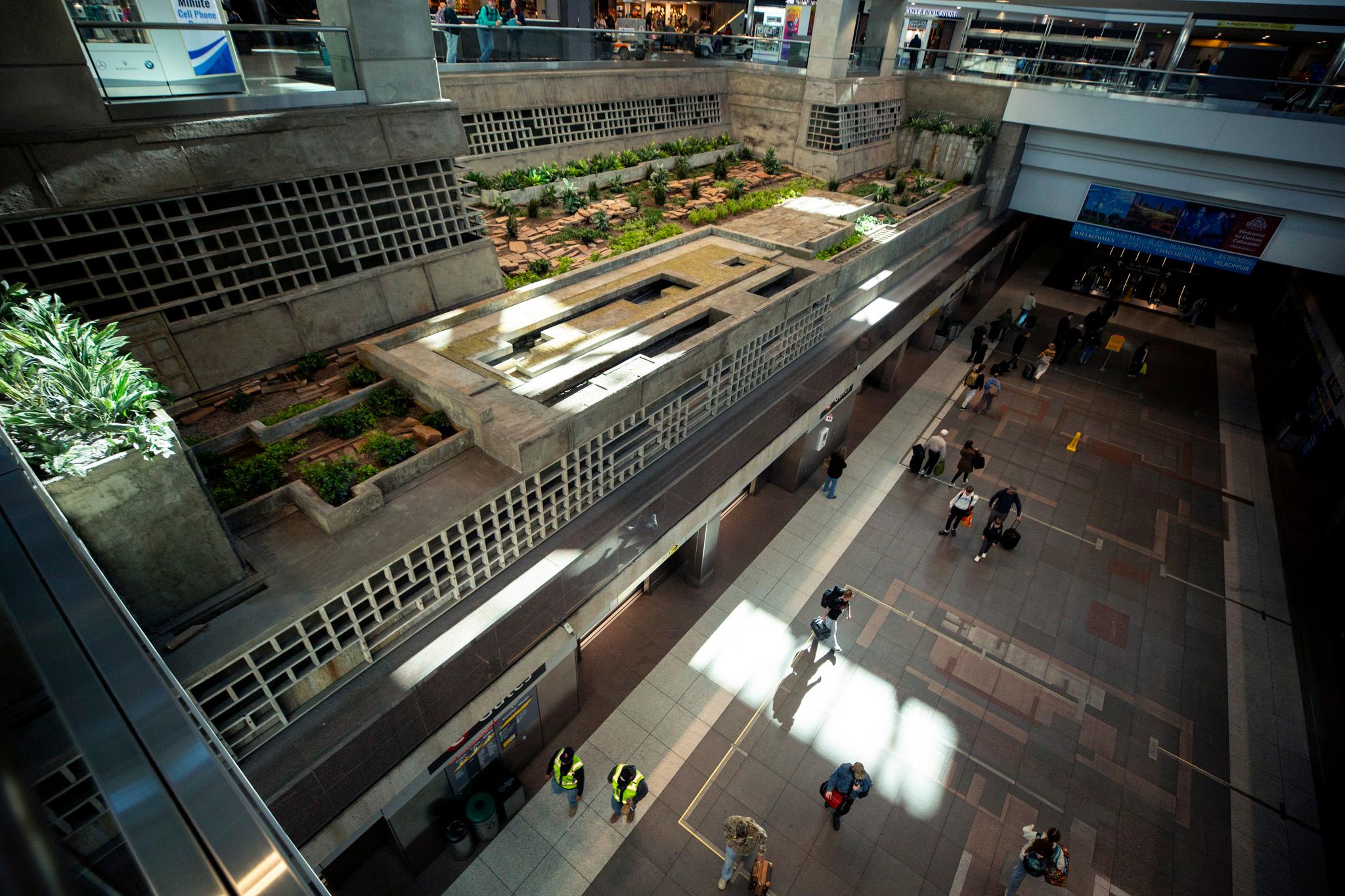
The garden originally included moss and ferns that crept over the base sculpture during the growing season, giving travelers the impression of abandonment. But the air of ruin turned out to be more authentic than Singer intended—poor waterproofing during initial construction led to numerous leaks in the work’s irrigation system which, being situated directly above DIA’s train system, required $2 million of repairs over the years, according to DIA.
The airport, tired of ongoing maintenance, announced its plans to remove the garden outright in 2017. This came as a surprise to Singer and Bregman, who said an outpouring of emails from airport-goers encouraged Singer to take a public stand against the deaccession.
Bregman even remembered hearing from workers at the restaurants near the garden. They thought the removal of the plants might drive away the concourse’s resident bird community.
“They were like, ‘We feed them French fries. This is their home,’” Bregman said. “An employee at McDonald's was emailing us about this! If that's not art, I don't know what it is.”
After negotiations, the airport commissioned Singer for a replacement piece. Per the agreement, the new piece will “utilize pieces of the current installation,” at least “to the extent possible.”
Though Toscano declined to give a specific timeline, he said it would likely be several years before either project got started. Back in 2017, airport officials budgeted $495,000 for the new piece, while estimating that the garden’s removal would cost $650,000.
What will replace the airport garden?
While the timing is still up in the air, Singer Studio has finalized the “Suspended Summits” concept and the preliminary design was approved by the airport on Nov. 14. The piece will be composed of 53 hexagonal panels—one for each fourteener in Colorado—with carvings similar to those on the ruins in “Interior Garden.”
The exhibit will be suspended over Concourse C so that it can coexist with “Interior Garden” — or whatever remains of it — while leaving space for the airport’s future plans for the concourse.
The work means a lot to Bregman; “Summits” was the last piece Singer, whom Bregman worked with for several decades, fully designed before his death early last year.
“Michael felt, and I definitely feel it with him, that a lot of people were siloed in their fields, so you'd have environmentalists that were primarily focused on conservation and you'd have engineers that were primarily focused on just building what they needed to build,” Bregman said. “He really felt that a lot of the problems in the world, especially environmental problems, could be better solved if people just work together.”
Many of Singer’s works have some sort of regenerative aspect—for example, The Scramble, a Singer sculpture in Chattanooga, Tenn., collects and filters stormwater, while the South Cove Regeneration Project outside West Palm Beach, Fla., prevents shoreline erosion—but, due to the rocky history of “Interior Garden” with the airport and the practical limits of the concourse, “Summits” will be a standalone piece. Bregman added that he thought the work would carry on Singer’s legacy in other ways.
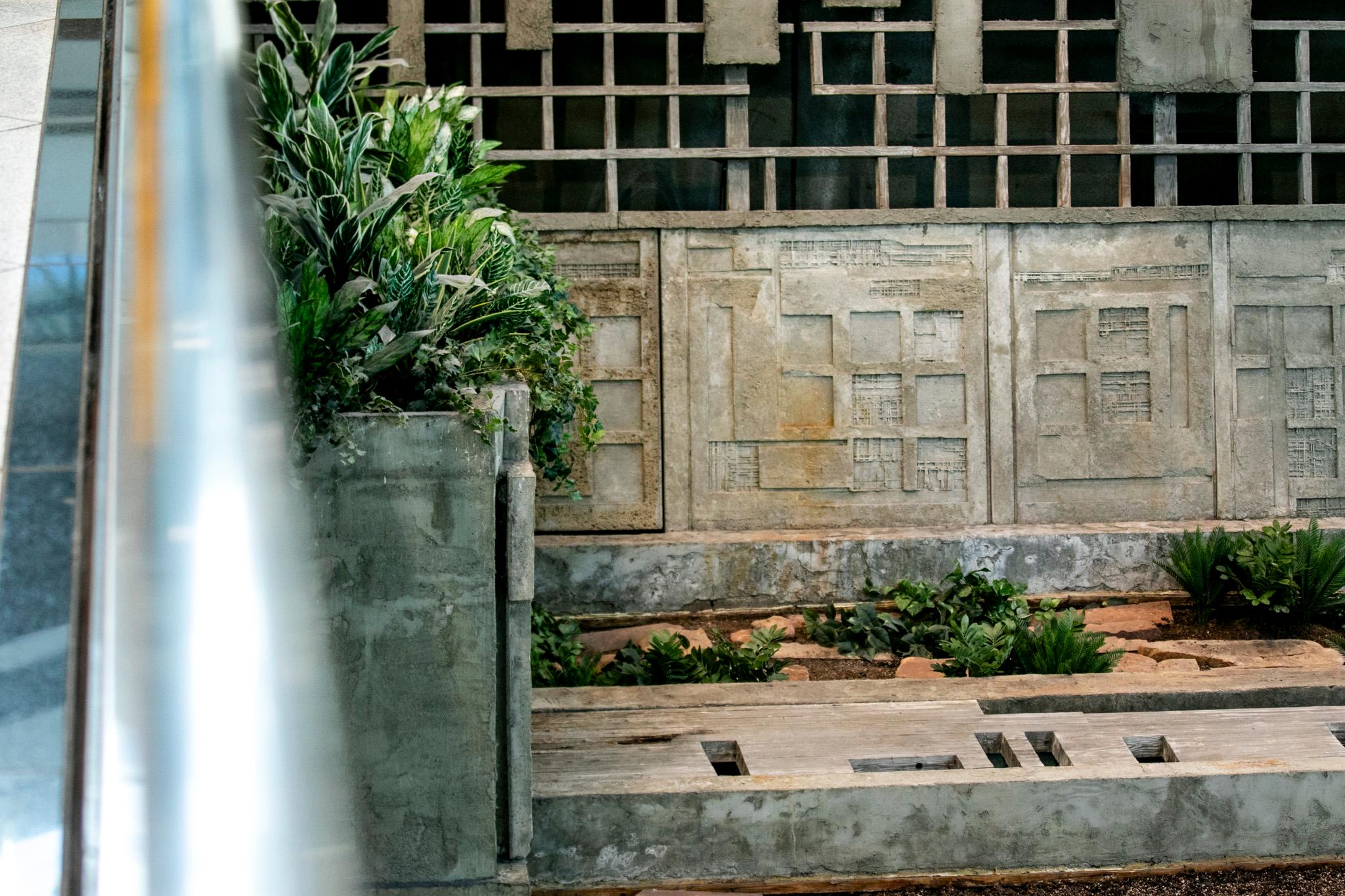
“It couldn’t really have much of an environmental function (because) it’s encased within the airport, but it's a pretty great space for light. (Michael) felt it was kind of like a cathedral, and so he really wanted a suspended piece … to work with that light and to really bring people's attention to the space,” said Bregman, adding that “Summits” would mirror some elements of the garden.
“They don't look anything alike, but there'll be certain references that reference the garden so if the garden does get taken out, some little traces of the garden’s geometry and things like that will be present,” he added.
The panels will be arranged, Bregman said, according to the relative geographic locations and heights of Colorado’s tallest peaks, with small adjustments to accommodate the airport’s laser smoke detectors. And the color? Aquamarine, like Colorado’s state gemstone, which crystalizes in hexagons (hence the panels’ shape).
Maintenance for “Summits,” in theory, will be much simpler. The panels will be suspended from a metal rack, which will be attached to a winch that airport employees will use to lower the piece for service and cleaning.
Airport officials said they are working on an engineering study about how the winch will work. Once that is finished, DIA will start applying for city permits for the new structure, and then fabrication of the actual piece can begin.
“We work on their timeline,” Toscano said. “We work with the artist or, in this case, Singer Studios, to provide us (with) what their schedule looks like based off of their capacity to fabricate and install the piece. They haven't sent me a formal timeline yet, so I don't know exactly when it's going to come in or how long they need for each phase.”
The studio is still debating what kind of material to use for the panels, though Bregman said it would likely be either aluminum or stainless steel. Once that is good to go, they’ll be ready for fabrication — though he had a slightly different impression of the timeline than Toscano.
“It’s really all dependent on the airport,” Bregman said.
Saying goodbye … at some point
Between debate over the garden’s fate, COVID-19 and standard city bureaucracy, the years since the 2017 agreement have passed quickly. And with the timeline still in flux, the garden likely has a number of final days ahead of it.
For Marie Sugio, a traveler from Hawaii who saw the garden for the first time on a recent trip to Denver, that’s a small win. When she heard about the airport’s plans to decommission it, her immediate reaction was, “No, they should keep it!”
“It’s so cute,” Sugio said. “Maybe because I just like plants, [but] any cities that I visit, I just love having a garden nearby. It gives that kind of same feel to it.”
Though Toscano said he understood that “Interior Garden” was irreplaceable to some, he thought “Suspended Summits” would be a “pleasant surprise.”
“I don't want to say their concerns will be met, because it's an art piece, right, so you still miss it when it's gone,” Toscano said. “But I think for those that are concerned about losing a showpiece work of art in the central space of the airport on Concourse C, I think their concerns will be put to rest, hopefully, once they see that new piece getting installed, because it will be very commanding and it is really beautiful.”
Regardless of when “Interior Garden” finally leaves DIA’s unusual pantheon, travelers like Funk still appreciate the airport’s collection.
“I don’t know that it’s worth millions of dollars to change it, but it’s unique to Denver,” Funk said. “We don’t have enough public art in our country and I think it’s a good place to display (it).”