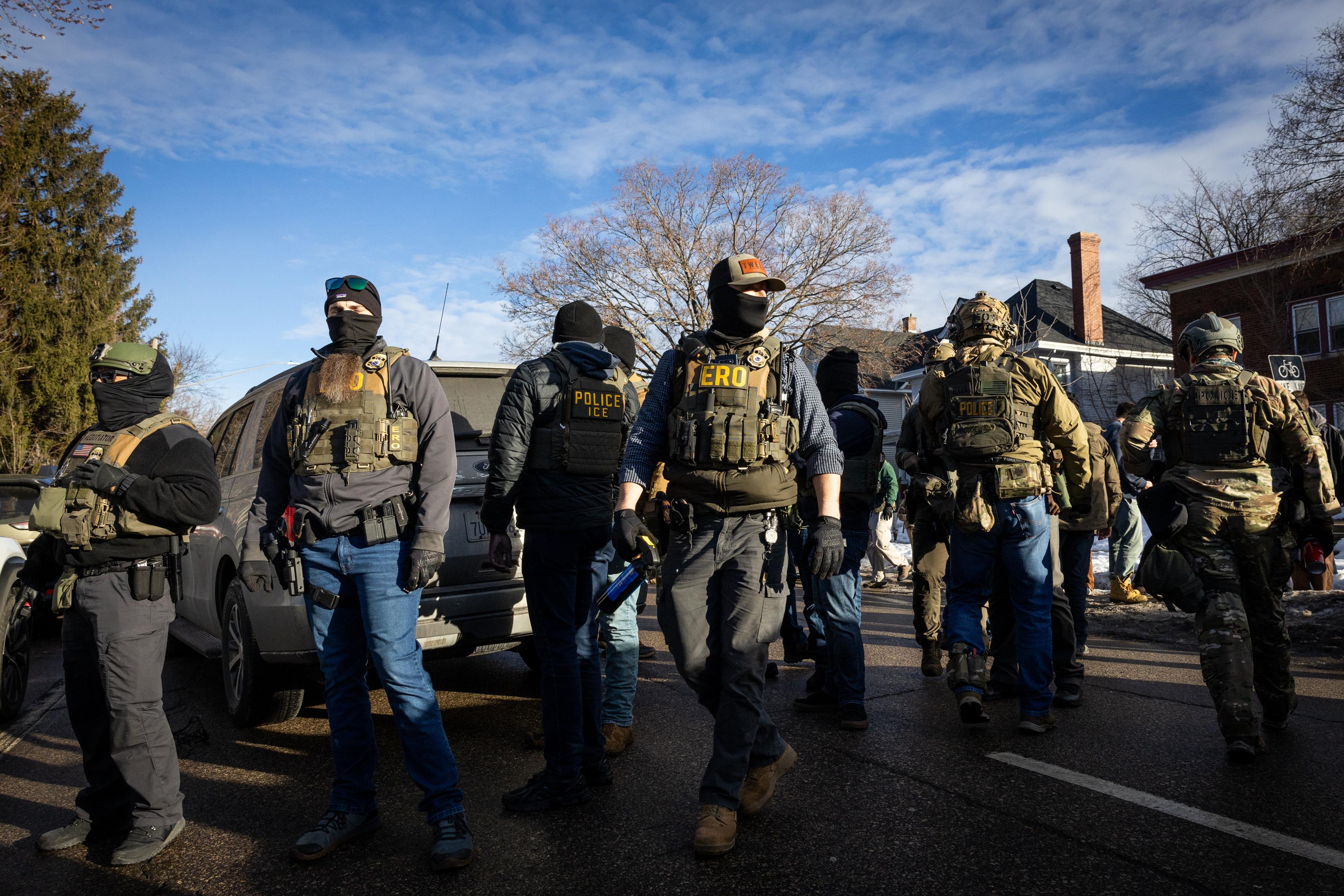
The Denver City Council on Monday banned law enforcement agents from concealing their identities while on duty. The prohibition applies to local, state and federal officers.
“It's not anything that we ever planned or thought of passing, until last year when we started seeing mass agents harassing people across our country and even before we saw anyone get murdered,” said Councilmember Flor Alvidrez, a sponsor of the bill, at an earlier meeting.
The law is part of Denver’s broader legal effort to push back on immigration enforcement. Last week, Mayor Mike Johnston issued an executive order that bans immigration agents from operating on city property, including roads and parks.
Councilmember Shontel Lewis said she and Alvidrez began work on the bill even before immigration agents killed people including Keith Porter Jr., Renee Nicole Good and Alex Pretti.
"In the intervening months, unfortunately, we've seen why this policy is so necessary," Lewis said. "I'm proud of the bill that we have here tonight, though there's always room for improvement, and I hope that we may serve as a model for other municipalities across the country ... With the passage of this bill tonight, we will increase transparency, we'll increase accountability and protections for the citizens of Denver."
The Trump administration has argued that masks protect officers from harassment and violence, while civil liberties groups say the masks undermine public trust, enable bad behavior and fail to maintain basic transparency.
Local police will have the authority to arrest or cite other officers, including immigration agents, to enforce it.
All 12 present council members voted in favor of the ban. (Councilmember Sarah Parady wasn't present.) The bill is set to take effect soon, though it needs a signature from Mayor Mike Johnston first.
“Sanctuary politicians attempting to ban our federal law enforcement from wearing masks is despicable and a flagrant attempt to endanger our officers," said Deputy Assistant Secretary Lauren Bis of the Department of Homeland Security. "To be crystal clear: we will not abide by unconstitutional bans. The Supremacy Clause makes it clear that state politicians do not control federal law enforcement.
Here’s how the new law would work.
Law enforcement would be required to take off facial coverings when detaining, arresting or restraining a person’s physical movement. The ban would also apply when they’re in city facilities.
It would not apply to officers who are undercover or carrying out certain tactical and emergency operations. It also wouldn’t apply to medical masks and protective gear.
Additionally, officers in nearly all engagements would have to wear identification including their name and badge or ID number. And all officers, including those like detectives who rarely wear identification, would be required to share their name and badge number when asked.
Denver’s not the first.
California passed a pair of similar laws banning masks and requiring identification. That state’s mask law was blocked by a federal court. But that was because it only applied to federal officers, city officials said.
The judge did not block California’s identification requirement. New Jersey and Washington are also among the states considering their own mask bans for law enforcement.
Meanwhile, conservative lawmakers have passed their own-anti-mask laws in recent years, but for different reasons.
In 2024, Republicans in Nassau County, N.Y., and North Carolina passed laws prohibiting most uses of masks in public. Those policies were framed as responses to bad behavior at protests. New Jersey also passed a law penalizing disorderly behavior while wearing a mask.
Denverite’s Kyle Harris and Kiara DeMare contributed to this article.