Updated at 12:22 p.m. on Wednesday, April 8, 2026
Debra Johnson will leave her job next year as chief executive of the Regional Transportation District, ending a difficult tenure that has seen RTD struggle to bring riders — and revenue — back to its buses and trains after a pandemic-era crash.
In an email to staff, Johnson said that she had declined a contract extension that had been offered by the agency’s board.
“I subsequently decided to decline the offer, recognizing my many years of service at RTD, as well as for personal and professional reasons,” she wrote.
The decision comes as RTD faces enormous pressure from the region’s political leaders, a looming budget crisis, and big questions about its future. Johnson will leave the role when her contract expires in May 2027.
“She’s had to live in the fire — not just jump through it, but live in it,” said former board chair Angie Rivera-Malpiede. “It didn’t matter what she said or what she did, she would always be ridiculed. Everyone has always been very eager to criticize RTD.”
Johnson, whose salary is $421,878, was picked for the role in August 2020 and started work in November of that year. At the time, RTD was struggling with a severe drop in ridership.
Use of the agency’s trains and buses fell by more than half amid the pandemic and has struggled to regain ground. Ridership fell again for parts of 2025, due in part to a sprawling effort to repair tracks.
The start of her leadership run was “a time of uncertainty and shifting priorities,” Johnson wrote. “I also remember this team coming together and employees rolling up their sleeves, traits that are still exhibited by staff.”

The start of her leadership run was “a time of uncertainty and shifting priorities,” she wrote to staff. “I also remember this team coming together and employees rolling up their sleeves, traits that are still exhibited by staff.”
RTD also has struggled with an exodus of senior leadership and a major budget crisis during Johnson’s nearly six-year tenure.
RTD confirmed that Johnson had declined an offer to extend her contract. The terms of the proposed extension haven’t been released. Johnson’s original contract was for five years, but the board previously gave her an 18-month extension into 2027.
“I think it's a good move,” said June Churchill, a leader with the advocacy group Greater Denver Transit. “RTD is an agency very much in need of change.”
Johnson did not immediately respond to requests for comment.
'A torrent of uncertainty'
RTD runs buses and trains through eight metro Denver counties, serving cities including Denver, Boulder, Broomfield and Aurora. The district is governed by a 15-member board of directors that appoints the CEO.
During the pandemic, safety issues plagued buses and light rail trains. In the years since, Johnson has appointed new leadership for RTD’s police department and expanded the number of officers riding across the system.
“It was just a torrent of uncertainty, and she really rose to the level,” Rivera-Malpiede said of the agency’s pandemic response.
The agency also has worked to revamp its services and restore more frequent service for some lines — a change that could rebuild ridership.
But the challenges haven’t ended. Ridership has gone up and down, and RTD is now facing a $215 million budget gap, amid ongoing gripes about the quality of its services, which are funded by riders’ fares and sales taxes.
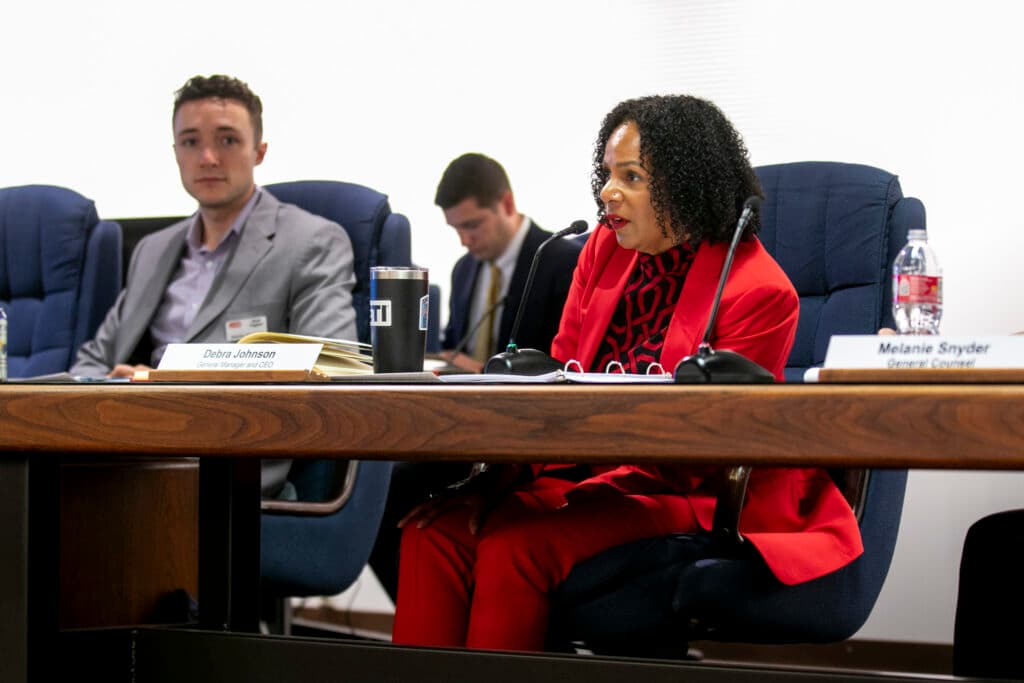
Some have questioned Johnson’s leadership skills, with some former RTD leaders alleging Johnson was an insulting micromanager.
“I was so broken down by this leadership style,” a former senior manager told CPR in 2024. “There was never anything to look forward to. I would classify it as an abusive relationship.”
At the time, Johnson said she was dismayed by the comments.
“She’s really dealt with some serious morale issues, I think, on the staff. There’s been a great exodus of folks,” Rivera-Malpiede said, though she added that some of the turnover was to be expected.
Johnson also oversaw controversial pricing changes to a program for people with disabilities. She previously was the deputy CEO of Long Beach Transit in California.
Board chair Patrick O’Keefe said Johnson would “work closely with the board” to ensure a smooth transition. He praised her work on topics like maintenance, security and labor.
“The agency is in a much better place because of her dedication,” he wrote.
Churchill, of Greater Denver Transit, said Johnson was dealt “a really tough hand of cards,” but that the agency had fallen short.
“I'm very thankful for her long years of service in that regard. But RTD’s post-pandemic ridership recovery is worse than almost any other agency in the country,” she said. “There's also a distinct lack of trust between many elected officials in RTD, and while we've seen progress in some areas, it certainly has not been fast enough.”
RTD’s next leader will face a fundamental challenge.
It simply doesn’t have the funding to effectively serve such a large service area, according to Rivera-Malpiede.
The next CEO will need to meet with leaders across the region and set a realistic strategy, she said. That may include changes to service or new funding streams.
“They will never be successful unless they really look at a total reset,” Rivera-Malpiede said. “It’s not just looking at the structure of the board but the geographic footprint that RTD will have to serve. It’s going to be a heavy lift for whomever comes into that position, but also for this board, to really reset the entire dynamic and how people perceive RTD.”
Meanwhile, RTD leadership has come under fire at the statehouse, where lawmakers have again proposed dramatic changes to its elected board.
RTD has already launched a comprehensive review of its operations, which could lead to significant route changes.
Another political question: RTD has failed to complete a long-promised train from Denver to Boulder and other elements of the tax-funded FasTracks program — a problem that began long before Johnson arrived.

The broken promise has irked regular people and influential politicians like Gov. Jared Polis. And it’s a major reason that the state of Colorado has pursued Front Range Passenger Rail, which will connect Pueblo to Fort Collins and cities in between, including Boulder. RTD is expected to play a significant role in the project, but many questions remain.
Ultimately, the agency’s next CEO may have to convince taxpayers, lawmakers and riders to support a sweeping new vision for the agency — one that may focus on more frequent service for the densest areas, rather than the agency’s full multi-county footprint, advocates say.
“The albatross hanging around RTD’s neck is this over-20-year-old plan for light rail expansion and commuter rail expansion, which fundamentally does not respond to the modern needs of the Denver metro area when it comes to transit,” Churchill said.
“So we need someone who's able to turn the page on that effectively and also effectively guide the agency through some really serious fiscal challenges, as well as navigating the complex political waters of the state legislature and potential RTD reform.”
It’s a “make or break” moment, she said.
Paolo Zialcita contributed to this article.