Updated at 10:54 a.m. on Friday, Jan. 9, 2026
After Denver International Airport shelved plans to study building a nuclear power plant, officials will instead gather ideas for a broader range of “clean energy solutions” to help meet its growing electricity needs.
The airport, the world’s sixth busiest and one of Colorado’s biggest economic engines, released the request for information on Dec. 29. It asks private companies to suggest how their products or services could help the travel hub build electricity generation and storage into its existing energy distribution network. By gathering information, the facility hopes to find the best path to accommodate its expansion plans while meeting its goal to zero out its climate impact by 2040.
“We were flexible in this regard, going to a broader perspective on clean energy,” said airport CEO Phil Washington in an interview with Denverite. “It was a lesson for us. We did not do it right the first time, and we went back and corrected that.”

The revised request follows public blowback to its original plan to investigate nuclear power. In August, Washington and Denver Mayor Mike Johnston announced a $1.25 million study into whether the airport should build a small modular reactor, a novel type of nuclear power plant with a far smaller footprint than traditional designs. Washington promised the idea could help turn Denver into “the Silicon Valley of nuclear energy.”
That vision, however, failed to win over many nearby residents and local elected officials, who feared safety risks and environmental impacts. The airport withdrew the proposal days later to allow for more public input.
Washington said the latest revision reflects feedback from six community meetings held in recent months. While it doesn't rule out nuclear power, it solicits proposals from companies to explain the benefits and risks of different energy technologies. It also raises the possibility that the airport could someday venture into a role typically reserved for utilities like Xcel Energy: selling electricity to nearby customers.
Why DIA is hungry for electricity
Airports around the world expect a rapid increase in electricity demand over the coming decades as buildings, cars and even aircraft shift towards electricity over fossil fuels.
DIA is no exception. The facility is adding gates, building a new rental car facility and plans to increase its capacity over the coming decades from roughly 83 million passengers last year to 120 million annually by 2045. A recent analysis found those factors could more than triple the airport’s peak power demand by 2040.
Washington expects the actual demand could be far higher if airlines adopt a new generation of all-electric aircraft. In addition, the airport is exploring whether to shift to an electric heating system to meet its climate goals. Altogether, he expects the facility's peak power usage could rise to 400 megawatts by 2045, a nearly ninefold increase over its current electricity demand. Colorado Springs, by comparison, has a peak power demand of about 1,000 megawatts.
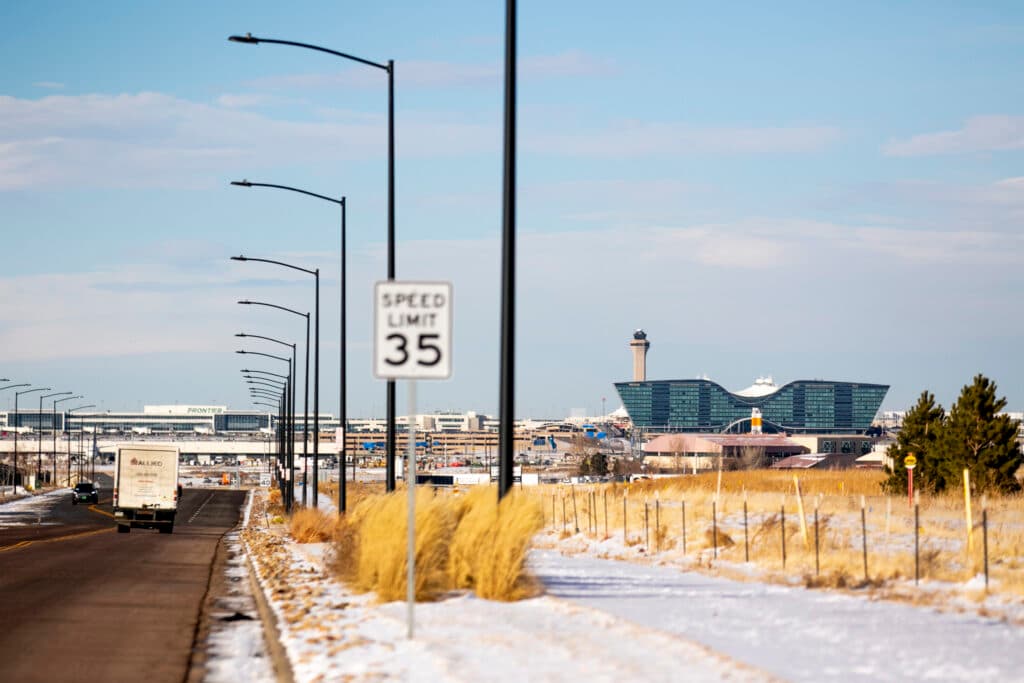
Besides providing electricity, an onsite power plant could help guard against blackouts, which recent history suggests can cause major international travel disruptions. Last year, for example, a substation fire knocked out electricity at London’s Heathrow Airport, leading to the cancellation of more than 1,000 flights.
“We don't want to experience that,” Washington said. “We can't afford to be down. So we are doing…the responsible thing of making sure that we are redundant as it relates to energy.”
Denver’s airport already has more than 230 acres of solar panels positioned around its terminals, and plans to add additional arrays in the near future. Washington said additional clean energy systems could help ensure the facility always has access to electricity, even as its power demand multiplies over the next few decades.
Other reasons for DIA’s interest in electricity
The airport, however, appears to have ambitions beyond meeting its own energy needs.
In both its original nuclear energy proposal and the revised request, DIA raises the question of whether it could someday sell electricity to other nearby customers. The possibility could mean the massive 53-acre airport might want to serve a role similar to Xcel Energy, Colorado’s largest utility and the airport’s current electricity provider.

The airport also has detailed plans to lease some of its massive area for private development. Both Washington and Mayor Johnston have discussed the possibility of attracting data centers, which require vast amounts of electricity to run the computer processing behind artificial intelligence.
Denver City Councilperson Stacie Gilmore, who represents the airport and its surrounding neighborhoods, thinks those ambitions might explain the recent focus on new power plants. She suspects airport officials want to ensure it can offer plenty of electricity to support future development, either on its property or nearby.
“It's about development. It's all based on money,” Gilmore said.
The recent clean power proposals also come after Swire Coca-Cola, a soft drink distributor, canceled plans to build a bottling plant on airport property, citing concerns over whether Xcel Energy could deliver sufficient electricity to the site.

Gilmore had previously criticized the possibility of building a nuclear power plant at the airport. She now wonders why the airport couldn’t work collaboratively with Xcel to develop a solution that might benefit the broader region. She said the utility plans to brief the city council on Jan. 26 to explain their plans to support the airport’s energy needs.
Sydney Isenberg, a spokesperson for Xcel Colorado, said Gilmore has invited Xcel to give a presentation about its plan to serve the airport moving forward, but further details about the presentation haven’t been finalized.
“Xcel Energy has consistently met the airport’s energy needs and will continue to do so. We have planned for the airport’s growth and are actively working with airport and city officials to ensure all energy needs are met now and for years to come,” Isenberg said.
Washington, however, denied that the recent interest in an onsite power plant is primarily about attracting development. Whether it's a small modular nuclear reactor or another energy source, he said the airport needs to find a way to keep the lights on.
“In my mind, it's about energy redundancy for this airport, which is, of course, the largest revenue generator in the state of Colorado,” Washington said.