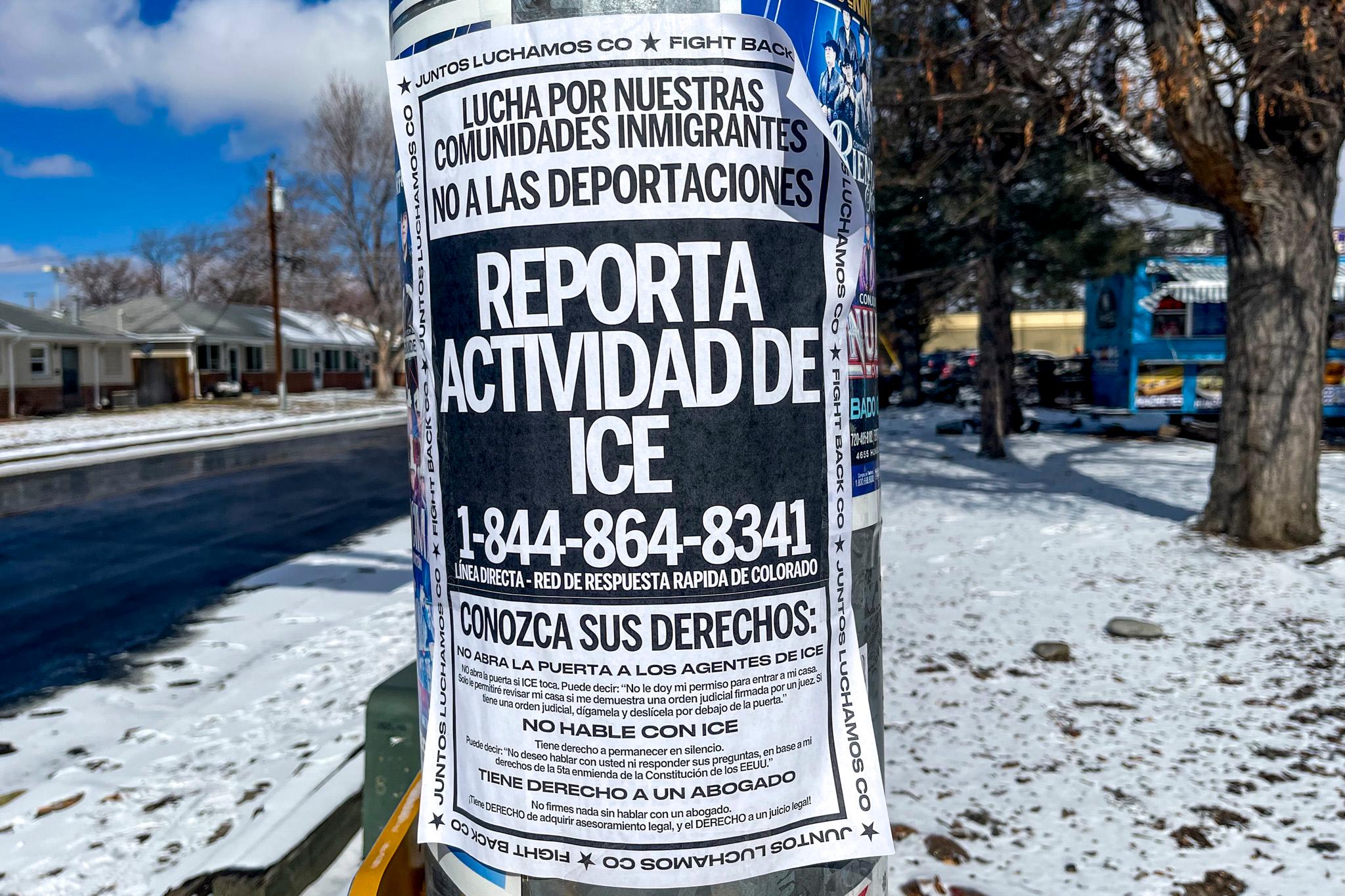
Aurora's new progressive-leaning city council on Monday declared its opposition to “overreach” by Immigration and Customs Enforcement on Monday. The council voted 6-4 to approve a resolution that criticizes ICE for infringing on people’s constitutional rights and calls for the city to limit cooperation with immigration agents.
The measure says that Aurora opposes “unlawful and overreaching federal immigration enforcement actions” and affirms "constitutional due process protections.” The resolution was a response to an ICE agent’s fatal shooting of Renee Nicole Macklin Good in Minneapolis last week.
Monday was the first city council meeting since the November council election, in which a progressive majority took over the city council.
The meeting was packed with residents from Aurora and beyond who mostly spoke about the resolution. Many people in the crowd said the resolution was a needed response to the killing of Good, who was from Colorado Springs.
"I'm speaking in solidarity with the many people in this room who are showing up to defend due process, dignity, and human life. The context for this resolution is already painfully clear,” said Aurora resident Ally, who did not give her last name, during the public comment session.
She continued: “A U.S. citizen from Colorado was extrajudicially killed during a federal immigration operation. Her life was taken without any access to due process and she's not the first one."
The resolution, sponsored by Councilmember Alison Coombs, passed 6-4. Council members Stephanie Hancock, Françoise Bergan, Angela Lawson and Curtis Gardner voted no.
The resolution is about 250 words in total. It describes the killing of Good as extrajudicial and also cites reports of “an unmanaged illness outbreak” at the immigrant detention center in Aurora.
“This facility is a stain on our city where 20 percent of residents are born outside the U.S.,” the resolution states. It also refers to a father and child being “taken by ICE” en route to a local school recently.
The resolution declares: “The Aurora City Council stands in solidarity with the Twin Cities in their call for ICE to leave their community immediately.”
Hancock questioned the constitutional standard that ICE was breaking during immigration enforcement and asked what the resolution would change operationally. And she pushed back on the fact that the resolution was not brought to the public safety committee first, calling it disrespectful.
There is a public safety committee that meets once a month to discuss community safety, and Hancock is the vice chair of the committee.
The resolution was submitted as an emergency resolution to ensure that the conversation takes place at the next public safety committee meeting, according to Coombs.
“There wasn’t time to sit down and have a full legal analysis, take it to the policy committee, any of those items. That’s why the direction is to go to the policy committee,” Coombs said. “This resolution is about upholding state and federal law, respecting our obligation as a council and the obligation of the Aurora Police Department to also uphold those same laws.”
Coombs also said the resolution is not about sanctuary city rhetoric or removing federal authority to enforce immigration law, but rather to oppose ICE’s actions during crackdowns.
Aurora Police Chief Todd Chamberlain said the resolution could “come at a cost.”
In a written statement, he said that local police don’t enforce immigration law or detain people on behalf of ICE. But they still need to work with federal authorities, he argued.
“Federal partnerships are nothing new. Unfortunately, they have been exploited for political purposes,” he wrote. “Keeping these partnerships out of the equation of public safety will leave the community more vulnerable to crime and victimization.
Hancock said she was concerned that the resolution was more symbolic than anything. Those who supported the resolution said it was the first step in the conversation.