
Updated at 10:26 a.m. on Tuesday, May 5, 2026
The Trump administration sued the city of Denver on Tuesday over the city’s assault weapon ban.
The 37-year-old law violates the 2nd Amendment, the Department of Justice argues. The local law makes it a crime “to carry, store, keep, manufacture, sell, or otherwise possess assault weapons” in Denver.
The Trump administration had said it would not immediately file a lawsuit if the city agreed to compromise its ban, but city officials strongly rejected the threat.
Our original story continues below.
Denver Mayor Mike Johnston said Monday the city will not bend the knee to a legal threat from the U.S. Department of Justice over the city’s longstanding assault weapons ban.
Last week, Harmeet Dhillon, an assistant attorney general with the DOJ’s Civil Rights Division, wrote to Denver officials to inform them that the federal government intends to file a lawsuit in federal district court against the city and Denver Police Department for a Second Amendment violation.
“Law-abiding Americans own and use for lawful purposes literally tens of millions of AR-15 style rifles. Indeed, it is the most popular rifle in America. The City has banned an arm in common use for lawful purposes by law-abiding citizens. Therefore, the Ordinance violates the Second Amendment,” Dhillon wrote.
The ordinance bans the sale and possession of certain firearms within city limits.
The letter said the DOJ would consider delaying the lawsuit if the city were willing to negotiate an end to the ban. At minimum, the department requested Denver immediately stop enforcing the assault weapons ban, acknowledge the "unconstitutionality of the so-called assault weapon ban” and enter a court-enforceable consent decree that permanently prevents the city from banning assault weapons.
In a letter sent to the DOJ on Monday, Denver City Attorney Miko Brown described the request as “baseless, irresponsible, and a clear overreach of the federal government’s power.” Brown brought up several similar challenges to assault weapons bans across the nation that have failed.

“Therefore, even if your bald, unsupported statement that 'literally tens of millions of AR-15 style rifles' are held by private individuals is true (and you have presented no evidence showing it is), your point is irrelevant,” Brown wrote.
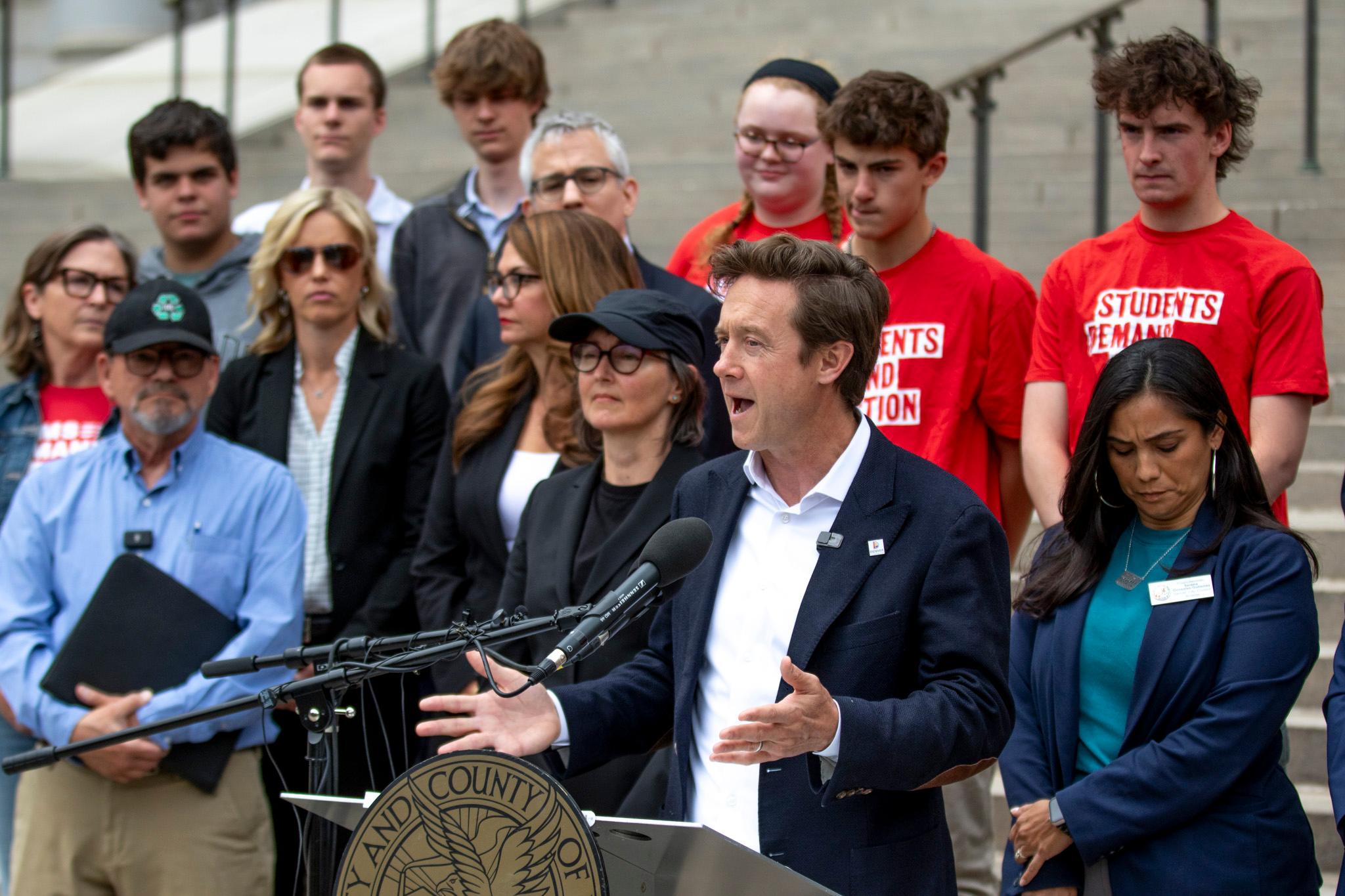
Johnston doubled down on the city’s defense of the ban on the steps of the City and County Building, flanked by Police Chief Ron Thomas, other city officials and gun control advocates.
“We're here today to let them know that our answer is ‘hell no,’” Johnston said. “No, we will not roll back a common-sense policy that has kept weapons of war off of these city streets for 37 years.”
The ban has been in place since 1989.
Denver City Council passed the assault weapons ban in 1989 following a spike in violent crime in the metro area. The ban came at the recommendation of Ari Zavaras, the police chief at the time.
“The city council hereby finds and declares that the use of assault weapons poses a threat to the health, safety, and security of all citizens of the City and County of Denver,” reads the Denver Code of Ordinances. “Further, the council finds that assault weapons are capable both of a rapid rate of fire as well as of a capacity to fire an inordinately large number of rounds without reloading and are designed primarily for military or antipersonnel use.”
Denver law defines an assault weapon as a semiautomatic pistol or centerfire rifle with a capacity of more than 15 rounds, or a semiautomatic shotgun with a folding stock and/or capacity of more than six rounds. A later amendment to the law also banned bump stocks, a device that allows a firearm to achieve a higher rate of fire.

The ban was almost immediately challenged, but has withstood several attempts to overturn it, according to The Denver Post. But this appears to be the first federal challenge to Denver’s assault weapons ban.
Police Chief Thomas praised the assault weapons ban, claiming it’s helped keep the city safe. While there’s been a dramatic surge in gun homicides in recent weeks, overall gun-related homicides have decreased under the Johnston administration.
“It's difficult to measure prevention, but I think that the fact that people cannot purchase, own, possess assault weapons in the city of Denver clearly has been a preventative measure,” Thomas said. “I know that of the 2,100 guns that were recovered in Denver last year, less than 40 of them were assault style weapons.”
Still, the department has struggled with curbing gun violence in recent years due to the proliferation of non-assault weapons in Denver.
The state also received a letter from the Trump administration.
Attorney General Phil Weiser’s office confirmed it also received a letter Monday attacking a statewide ban on large-capacity magazines.
The 2013 law outlaws the sale of ammunition magazines that can hold more than 15 rounds. It was passed in the wake of the mass shooting at a movie theater in Aurora in which the gunman used a 100-round drum.
Similar to the demand it made to Denver, the DOJ said it would delay filing a lawsuit if the state stopped enforcing the ban.

Weiser said in a statement that he would also not comply with the DOJ’s demands.
“The Colorado Supreme Court ruled unanimously that the state’s large-capacity magazine limitation law is constitutional under the state constitution, and I believe the law has reasonable limitations that satisfy Second Amendment protections,” he said. “Large-capacity magazine laws are responsible policies that decrease the deadly impacts of mass shootings and save lives.”
Johnston said he was unsure if other cities or towns received lawsuit threats. While he said he didn't know why Denver was targeted, he noted that the acting chief of the DOJ’s Second Amendment Section is Barry Arrington, who played a role in a 2019 attempt to overturn Colorado gun laws in a private capacity.
The Department of Justice did not immediately respond to Denverite's request for comment.
Editor's note: A previous version of this story misstated which statewide law the Department of Justice is targeting.