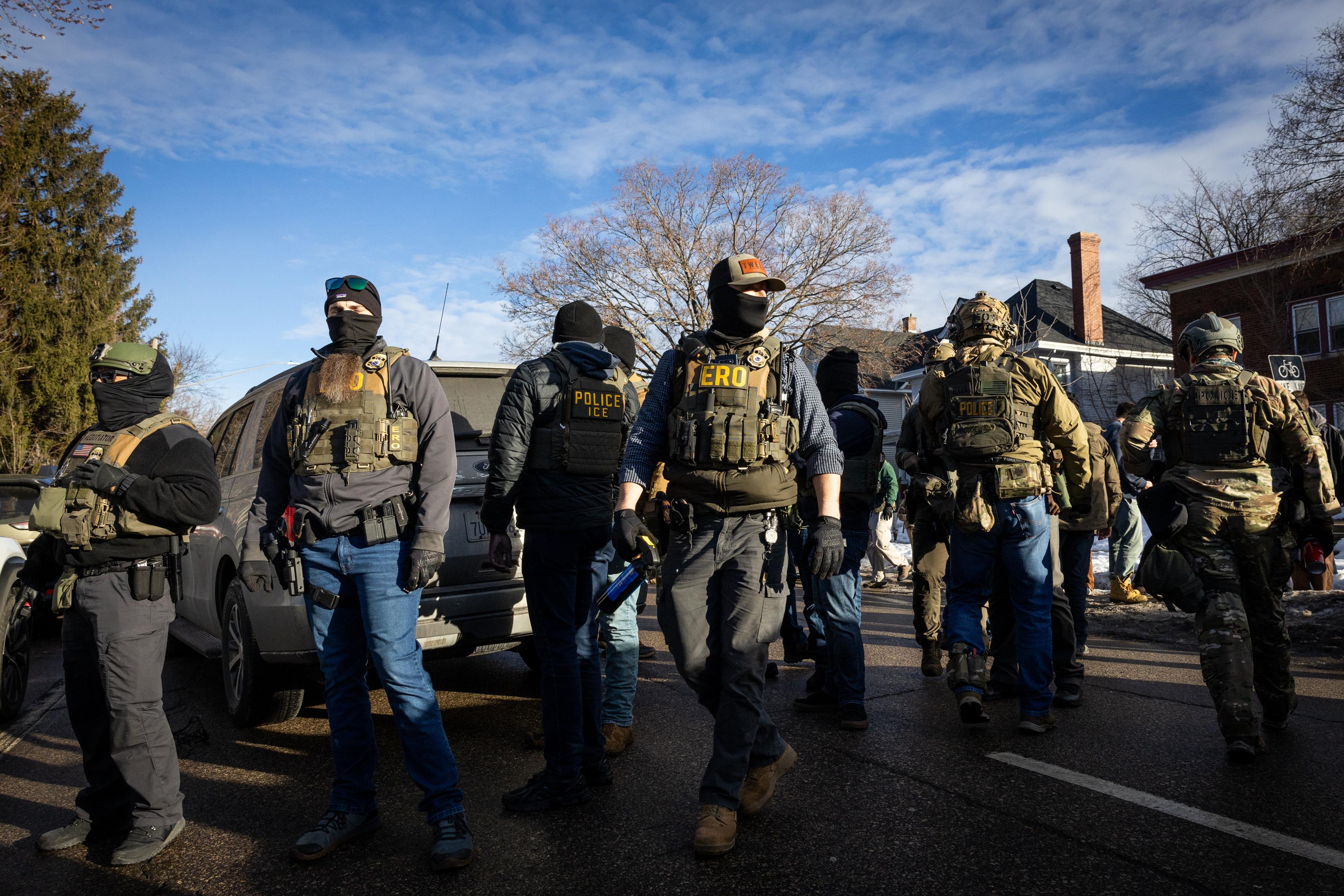
On Monday night, Denver City Council members advanced a proposed new law that would ban law enforcement agents from concealing their identities with face coverings. It’s a response, in large part, to the presence of masked immigration agents across the U.S.
“It's not anything that we ever planned or thought of passing, until last year when we started seeing mass agents harassing people across our country and even before we saw anyone get murdered,” said Councilmember Flor Alvidrez, a sponsor.
If implemented, Denver police could be asked to cite — or even arrest — fellow law enforcement officers, including federal agents.
Over the past year, Immigration and Customs Enforcement officers have concealed their identities with masks as they arrest people. The agency argued the masks protect officers from harassment and violence, while civil liberties groups say the masks undermine trust in both law enforcement and the federal government and fail to maintain basic transparency.
Called the Safety and Transparency in Public Authority Act, the Denver law would establish basic standards for visible law-enforcement identification.
The bill had its first reading without opposition, but won’t become law until the council takes a vote at an upcoming meeting.
Here’s how the new law would work.
Law enforcement would be required to take off facial coverings when detaining, arresting or restraining a person’s physical movement. And the bill would ban law enforcement from wearing coverings to hide their identity in city facilities.
Here’s how the city would define facial coverings: “An opaque mask, garment or headgear that conceals or obscures the identity of the agent of office such as balaclavas, gator masks, and ski masks.”
The law would not prevent officers from going undercover, carrying out SWAT duties and tactical operations or emergency responses, and it would not prohibit officers from wearing helmets, clear face guards, medical masks or protective eye gear.
Officers would be required to wear identification in nearly all engagements, including their name and badge or ID number. And all officers, including those like detectives who rarely wear identification, would be required to share their name and badge number when asked.
Law enforcement at all levels of government would be required to follow these rules in Denver.
Those who break the rules could be cited or arrested by the Denver Police Department.
The debate
Supporters, including the interfaith group Together Colorado, the Colorado Criminal Justice Coordinator, the Independent Monitor and the Clerk and Recorder joined other residents in supporting the changes.
“At its core, this legislation reflects a basic constitutional principle: when government
power is exercised over people in public, it must be visible, identifiable, and accountable,” proponents wrote in letters. “These standards are essential to community safety and to maintaining trust between residents and the institutions meant to protect them.”
The bill’s proponents argue it does not interfere with federal law and does not undermine federal rules regarding obstruction.
California passed a pair of similar laws banning masks and required identification. That state’s mask law was blocked by a federal court because, unlike Denver’s proposal, it only applied to federal officers, city officials said. The judge did not block California’s identification requirement.