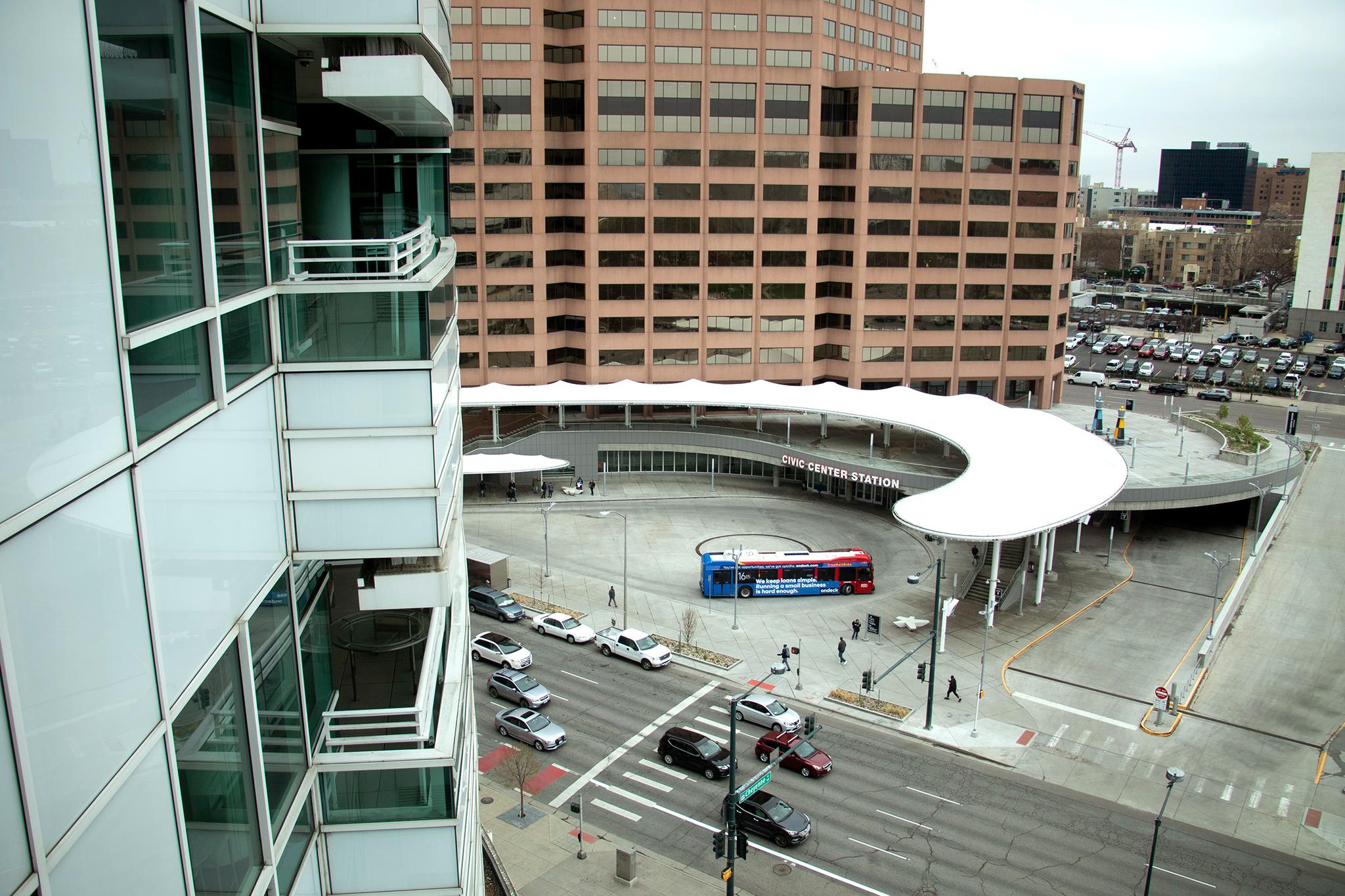
The Regional Transportation District officially renamed Civic Center Station on Jan. 19 to honor the Rev. Wade Blank, the disability rights activist who fought for transit access.
But the agency appears to have canceled a renaming ceremony that had been scheduled Thursday. The change came as RTD has faced criticism from disability rights advocates — and even Blank’s own daughter.
Caitlin Blank, along with the advocacy group ADAPT Colorado, is angry that RTD recently increased costs for a popular service for riders with disabilities.
“I state clearly that I do not grant permission for my father’s name to be used on any RTD property at this time. My family was never consulted before RTD moved forward with this proposal,” Caitlin Blank wrote in a letter. “Let’s be clear: renaming Civic Center Station after Wade Blank right now is not an honor—it is a publicity stunt.”
Blank co-founded Atlantis, an independent living community for people with disabilities. Atlantis gave rise to ADAPT.
“We don't want that sign going up and we don't want a celebration until we've got RTD really making some meaningful reforms,” said Mary Henneck of ADAPT Colorado.
The criticism is focused on RTD’s changes to Access-on-Demand, a service that provides flexible transportation on services like Uber. RTD recently raised costs for riders on the service, saying it was a financial necessity.
No ceremony, but the new name will stand
In a letter to ADAPT, an RTD leader said the ceremony was canceled, but the renaming will stand.
“RTD has stopped planning a celebration of the station renaming. The final components of the renaming will simply occur without fanfare. Perhaps someday we can arrange a celebration that is fitting of Rev. Blank and his constant push for improvement,” wrote Patrick O’Keefe, the chair of RTD’s elected Board of Directors.
ADAPT provided a copy of the letter to Denverite. O’Keefe was not immediately available for comment on Wednesday.
RTD previously noted that the renaming proposal came from “community advocates” with 28 letters of support from local organizations, as well as an endorsement from the Denver City Council.
O’Keefe said that he did not support a reversal of the name change, noting its broad community support, including from “many voices from within the disability community.”
But he added that he wanted to meet regularly with ADAPT and pursue accountability and “better outcomes” from RTD.
Service changes drew anger
RTD’s Board of Directors approved the changes to Access-on-Demand (AoD) in late September in a 10-5 vote. O’Keefe, the board chair, opposed the change.
The service will continue, but RTD is now covering only $20 of each ride’s cost, down from a maximum of $25 currently. Riders also will pay a base fare of $4.50 per ride, or $2.25 for those who qualify for RTD’s income-based discount program.
Dawn Russell, an RTD user and ADAPT advocate, said that while she appreciates the name change, RTD should be focused on reversing its recent changes to the AoD program.
“We appreciate the work that has gone into (the renaming), but the timing certainly doesn't speak the values of now,” Russell said. She said she was pleased about the chance to meet with RTD leadership.
Access-on-Demand launched as a pilot project about five years ago. It offers subsidized, on-demand rides for qualified riders via certain ride-share and taxi companies. The flexibility and affordability appealed to paratransit riders, boosting its popularity quickly.
RTD officials have said increasing ridership has made AoD unsustainable. Overall, RTD is operating a record $1.5 billion budget in 2026, but it faces a “structural” deficit and officials have said they’re worried about the long-term budget implications of the on-demand paratransit program.
ADAPT unsuccessfully sued RTD in an attempt to stop the changes.
ADAPT’s long history of fighting RTD for accessibility
ADAPT has a rich history of protest. The Gang of 19, a group of people with disabilities, blocked the intersection of Broadway and Colfax in July 1978. They successfully halted RTD buses for about 24 hours. Blank joined them as a supporter and organizer. It was part of a successful movement to make Denver’s bus fleet accessible for wheelchairs.
The group was a driving force in demonstrations at the U.S. Capitol in 1990, urging federal lawmakers to pass the Americans with Disabilities Act.
Henneck, with ADAPT, said that they will continue to fight for accessibility in public transit.
“RTD has made it clear their No. 1 priority is increasing ridership, but apparently not for people with disabilities,” Henneck said. “They are failing the most in need, the people who are most dependent on public transit and they're failing this community miserably.”
Wade Blank was an "iconoclastic minister and civil rights worker,” as one remembrance put it. He believed in a “liberated community,” or a “society where human beings could live in equality and develop the power to effect change.”
Blank died in 1993 alongside his 8-year-old son, Lincoln, whom he was trying to rescue from a riptide.
RTD’s website already reflects the new name of Wade Blank Civic Center Station, which stands just blocks from the site of the Gang of 19 protest.
But the agency hasn’t yet installed the signage that will make Wade Blank’s name a daily part of life for some 15,000 passengers.
“Adding Rev. Blank’s name to Civic Center Station serves as an ever-present reminder that while we have come a long way, we have a long way still to go,” O’Keefe wrote in his letter to ADAPT.