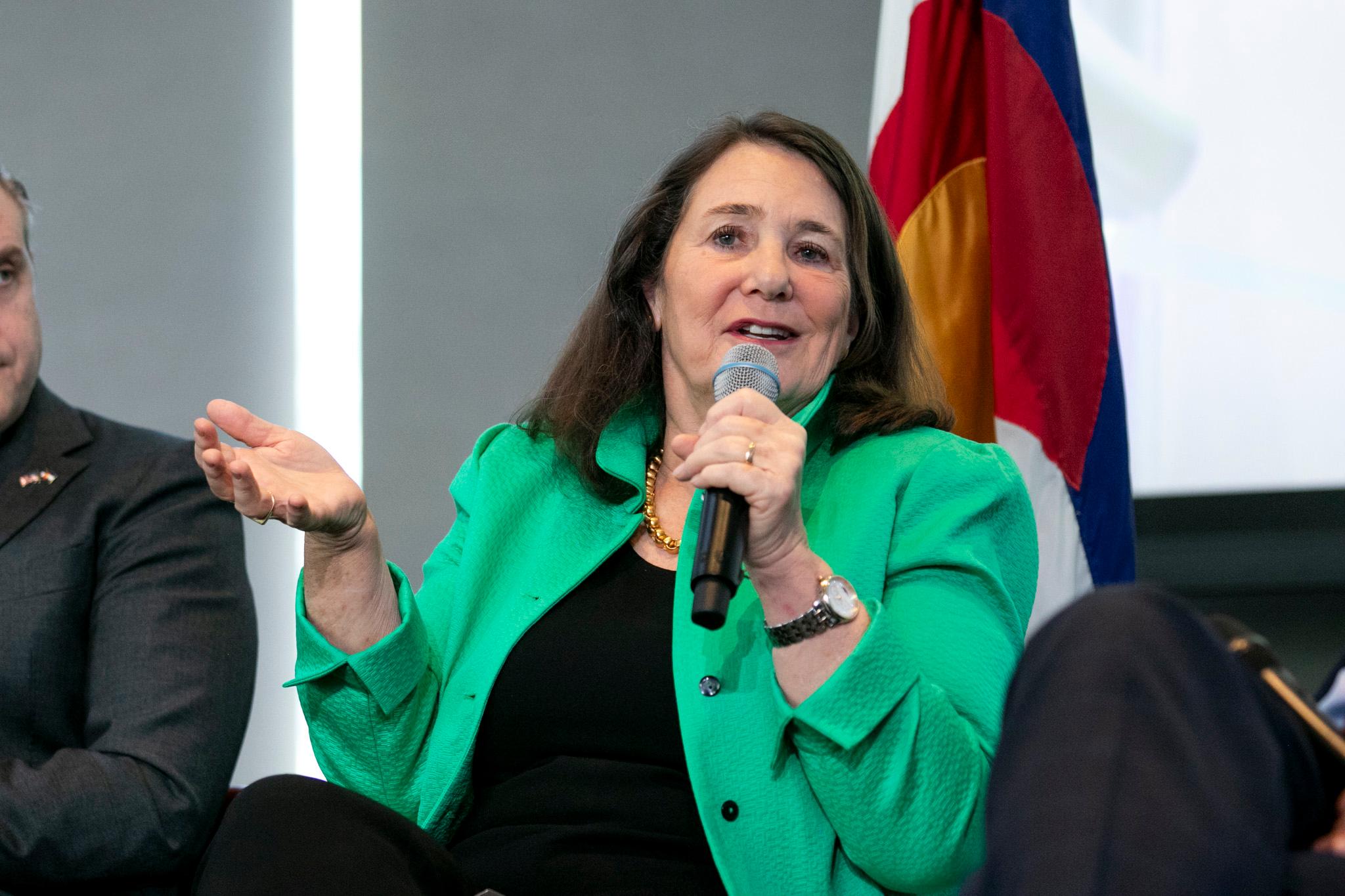
Rep. Diana DeGette avoided a campaign disaster, securing enough delegates on Friday night to place her on the ballot for the Democratic primary election for the 1st Congressional District.
However, DeGette was dramatically outperformed at the party meeting by one of her challengers, Melat Kiros, a Democratic Socialist. After winning strong support among party members, Kiros will appear first on the ballot in the June primary.
Another challenger, CU Regent Wanda James, also may appear on the ballot.
Kiros took a strong majority of delegates in the caucus and assembly process, surprising DeGette’s supporters. DeGette took 77 votes and Kiros 158 votes in a near-final count, although an inconsequential number of votes were still outstanding.
“When you think about what this district and our country needs right now, not five years ago, but right now, what does that look like?” Kiros said at the assembly meeting. “I believe it looks like a representative who doesn't have to choose between the people who funded her campaign and the people who need her to fight.”
DeGette had little room for error.
At an earlier party meeting, she had secured just enough preliminary support to make the ballot. Candidates must secure 30% of the delegates in the final assembly to have their name included in the ballot. In the end, DeGette secured 32.8%.
DeGette could have been left off the ballot if just a handful of her expected supporters switched their votes or failed to show up to the virtual meeting on Friday. But it appeared that few, if any, people did that.
"Our country is in a critical time and I intend to use my leadership to stand up to Donald Trump and his cronies as we defend our Democracy. When Democrats retake the House, I will hold a committee gavel — and I intend to use it," DeGette said in a written statement. "I am eager to return to Congress to continue fighting for Medicare for All, for the abolition of ICE, and a government that serves working families instead of the ultra-wealthy and their armies of corporate lawyers."
In the runup to the assembly, both campaigns raced to contact delegates and secure their support. The Kiros campaign said it would try to convince DeGette’s delegates to switch sides, while DeGette tried to hold the line.
The rules of the caucus and assembly system left the campaigns in some suspense until the final vote.
“When you’re elected delegate from the county assembly, you are elected for a specific candidate, but that does not bind legally — you are free to switch and become a faithless delegate,” said James Reyes, vice-chair for the Democratic Party of Denver.
He confirmed that two delegates had been disqualified for potentially misrepresenting themselves earlier in the process — voting for one candidate in a preference poll and then becoming delegates for the others. But he said he could not recall which candidate those delegates had voted for. The delegates were replaced, and DeGette survived a wake-up call.
With the ballot settled, a new phase of the race begins. The primary sets up a battle between DeGette, an establishment Democrat, and two potential challengers. A third candidate, James, is trying to reach the ballot through a separate process.
While Kiros’ early victory gives her momentum, it’s no guarantee of success. In the past, progressive challengers in Colorado have done well at the assembly, only to be blown out in the popular vote in June.
The winner of the primary this spring will go on to the general election, which the Democrat is almost guaranteed to win because Denver leans heavily left.
The candidates
Kiros, a former lawyer and barista, ran a grassroots campaign that mobilized young voters to engage in the nitty-gritty of local politics: the caucus and assembly process.
Participating requires showing up at meetings and navigating potentially confusing rules, so it often has favored older voters. But Kiros used social media and savvy organizing to send supporters to the local schools and other sites where precinct meetings were held.
“This is a city that really believes in progressive values. It's the youngest district in the country, and I think folks are excited that there's someone who's actually offering a change,” Kiros said at a precinct caucus earlier this month. “Not just to fight against Donald Trump, but to fight for something, to fight for a vision of a better tomorrow.”
Her campaign mirrors that of Zohran Mamdani, now the mayor of New York City, a fellow Democratic Socialists of America member who rose to prominence with grabby videos and a pro-labor message.
DeGette’s team said she’s looking forward to talking to voters through June and that she’s feeling confident. She portrays herself as a veteran leader who has fought for her district.
"Throughout her career, she has proudly stood on the front lines of major fights for justice, equity, and opportunity – championing health care access, reproductive freedom, environmental justice, workers’ rights, immigrant rights, and economic fairness for all," her campaign website states.
The James campaign did not respond to requests for comment. James has not yet been certified for the ballot, though her campaign said she submitted twice as many signatures as was required. She describes herself as a “warrior” on issues like the cost of living and is a cannabis entrepreneur.
As of Dec. 31, DeGette has reported raising about $713,000, Kiros about $205,000 and James about $180,000.
DeGette’s team made a potentially fateful decision early in the process: They could have secured a backup option to reach the ballot by gathering signatures from voters. Doing so would have ensured she made the ballot, no matter what happened at the assembly. But by the time the potential threat was obvious, it was apparently too late to do so.